Thursday, January 20, 2011

The Final Solution to the Conservative Question

Throughout its history, the United States has struggled to deal with the presence in its midst of a people who, while externally and superficially resembling normal Americans, are fundamentally and dangerously different in terms of their culture, habits, thought patterns, and religious beliefs. This subpopulation is known as the Conservatives. The problem of preserving the freedoms, tolerance, and equality on which we Americans have long prided ourselves, albeit often without full justification, while at the same time tolerating this quarrelsome, hostile, alien people amongst us has been termed by some of our best thinkers the Conservative Question.

The urgency of this problem has grown rapidly in recent decades.

At one time, Conservatives could be divided into Not Overly Conservatives, Strong Conservatives, and Utterly Wackadoodle Conservatives. For many years, the Utterly Wackadoodle branch was the smallest and most easily ignored. There was reason to hope that the Not Overly Conservatives could eventually be fully integrated into normal American society. It even seemed possible that the Strong Conservatives would moderate their beliefs in the face of reality, or at least that they could be marginalized and rendered harmless. But in the mid–1960s, the Utterly Wackadoodles began a strong resurgence. Over time, they managed to purge their ranks of all Not Overly Conservatives and most Strong Conservatives. It’s fair to say that now Conservative is nothing more than a synonym for Utterly Wackadoodle.

At the same time, Conservatives merged with the rising tide of religious insanity welling up from America’s mental dark places. Clearly this has not diminished the subrace’s utter wackadoodliness. Instead, it has led to constant attempts to rewrite American history. For example, Conservatives frequently advance the wackadoodle claim that America was founded on religious principles by religious wackadoodles. As their rantings increasingly drown out the sane voices of normal Americans, Conservatives have gone from being amusing zanies to a serious threat to American civilization.

Legally, of course, Conservatives have the same rights as normal Americans. For example, they must be permitted to live where they please, to vote in our elections, and even to marry our people! Understandably, despite the law, normal Americans are outraged at allowing Conservatives such freedoms and have sometimes reacted hostilely. In response, Conservative spokesmen have complained of a “blood libel” being used against them and a “pogrom” being waged against them. While such talk is typical of the absurd hyperbole to which Conservatives are naturally inclined, it is nonetheless true that normal Americans are becoming ever less tolerant of Conservatives, and it conceivable that this unhappiness could some day erupt violently. Thus the presence of Conservatives in America creates a danger to them as well to our national institutions, to which they have from the time of the founding of our nation expressed fundamental hostility.

Nominally, Conservatives worship the same god as the Monotheistic Majority. However, in practice they spend much of their time supplicating and bowing to an aspect of this god unknown to normal Americans: Invisible Hand. In the Conservative religion, Invisible Hand is the most important and powerful of God’s aspects. Invisible Hand controls almost every aspect of daily life, and blind, unquestioning worship of him is the way to solve even the most dire of mankind’s problems — peace, war, hunger, disease, global warming, etc.

This belief system leads to a combination of fatalism (humans can do nothing about such problems because Invisible Hand will either correct them or exacerbate them, and attempting to interfere with his will is presumptuous at the least, and Socialistically European at the worst) and feudalism (the strong must rule because clearly Invisible Hand favors them). This attitude is — or at least ought to be — anathema to all normal Americans.

While paying the same lip service to egalitarianism as do normal Americans, Conservatives are culturally and psychologically inclined toward worship of the strong man.

In politics, this causes them to constantly yearn for the semi–divine Messiah who will save them from the hordes of savages who surround them. This Messiah, they believe, will give them dominion over the nations of the earth. As shown by the examples of Ronald Reagan and George the Lesser Bush, the blanker the slate onto which they can project their poorly disguised homoerotic yearning, the better.

In the social and familial realm, Conservatives stick to their own kind. They are by nature insular and strive to isolate their children from outside influences that could lead them to question the faith and folkways of their parents. Needless to say, they strongly, even violently, disapprove of their children socializing with — or worse, dating or marrying — outsiders. So strong is their aversion to what they deem corrupting influences, that they even clamor to remove such influences from the wider society. Thus they oppose the teaching of certain areas of science in the public schools and the depiction in movies or on television of behavior their narrow–minded morality considers immoral. They hope to see public schools eliminated entirely, replaced by private academies in which children would be exposed only to the narrow, blinkered, provincial view of the world and of history favored by Conservative parents.

In the economic realm, Conservatives idolize the rich, who are clearly Invisible Hand’s favorites, and despise the poor, who must have offended Invisible Hand in some way. In their theology, no man occupies his position on the economic ladder because of forces beyond his control. The strong man they worship climbs to the top of the economic ladder by means of his own vigorous exertions and inner superiority, thus earning the approval of Invisible Hand. Therefore, the richer a man is, the worthier he is of respect, admiration, and emulation. His opinions on any subject at all are worth more than the opinions of anyone else in the same degree as his worth in dollars is greater than theirs.

Conservatives are true believers in natural aristocracy, class stratification, and the importance of bloodlines. However, they are ashamed to admit to this and pretend to be champions of a classless society, probably in part to make themselves more acceptable to normal Americans. This constant hypocrisy is bad for the health of Conservatives. The solution to the Conservative question proposed below will free them from this constant inner tension and will thus improve their mental and physical health, enabling them to live more pleasant and fulfilling lives — or at least, as fulfilling and pleasant as life can be for a people so inherently mentally and emotionally cramped, embittered, and poisoned.

Conservatives worship authority figures. They listen in rapt and worshipful attention to the ravings of hate–mongering zanies on radio and television, even if the hate–monger is a cigar–chewing walrus or a babbling crying man. They treat as gospel the rambling writings of a blonde female zombie or a sexy but deranged Filipina. This is clear evidence that they are utterly out of place in America and must be isolated to keep the rest of us safe.

One thing must be said for Conservatives: they’re good with money. Perhaps that’s because they think about it so much more than normal Americans do. Or it could be built into their genes, thanks to a long process of selection by means of in–group marriage. Unfortunately, they haven’t used this ability to benefit their country but rather to enrich themselves and add to their power and influence. Normal Americans suspect, with very good reason, that Conservatives quietly control the government and especially the economy. For example, a very brief examination will reveal that throughout its history the Federal Reserve has been dominated by Conservatives. This power is used by Conservatives in the interests only of other Conservatives, for Conservatives always take care of their own.

Of course this only increases the resentment and anger normal Americans feel towards Conservatives, increasing the chance that the isolated incidents of vandalism and assault that we see today will spread and exceed the government’s attempts at control — attempts that Conservatives grumble are halfhearted and insincere.

Normal Americans have many reasons for their anger. In addition to the financial and political control that Conservatives already exert far out of proportion to their numbers, it is widely suspected that the economic and social texts sacred to Conservatives — written in an obscure language understood only by a small number of Conservatives who constitute a virtual priesthood — assert that Conservatives are inherently superior to normal Americans and are destined to rule them. As mentioned earlier, they believe that Invisible Hand will send a Messiah who will lead Conservatives to dominion over all the earth. Many normal Americans are convinced that this has already happened without the help of a Messiah.

The situation has almost reached the boiling point. A solution must be found to the Conservative Problem. Interim solutions — e.g., isolating Conservatives in certain sections of our great cities — will not answer in the long term. No, a final solution is required.

The Final Solution to the Conservative Question is clear. It will be difficult, expensive, and long term, but it is the only humane answer to the question that has been plaguing America for so long. We must start with the following declaration, which is a general statement of purpose: “The United States government views with favor the establishment of a national home for the Conservative people, and will use its best endeavors to facilitate the achievement of this object.”

To fulfill this objective, we must decide on the location of the new homeland.

Conservative leaders with whom this project was discussed proposed choosing some landmass where the number of Conservatives is sufficiently low among the natives and quickly and brutally depopulating the place. Western Europe was high on their list. That some Conservatives would inevitably be among the dead is, in their view, an acceptable price to pay. They assured us that the dead Conservatives would ascend to their version of Heaven because “Invisible Hand will know his own.”

However, while such cold–hearted bloodlust is normal among Conservatives, it is unacceptable to the majority of normal Americans, or at least it should be. Therefore, the humane version of the Final Solution requires a massive, full–bore Manhattan–Project style undertaking to build a large island in the middle of the Pacific Ocean, to be called Handlandia, which will serve as the new Conservative homeland.

Some have suggested that Handlandia should be anchored to the sea bottom, first so that it stays in place and cannot float toward and thus endanger with cultural pollution any civilized country, and second so that Conservatives can be provided with a final lesson in the reality of global warming and rising seas. However, this would require the kind of cruelty and callousness, so common among Conservatives, that should not be exhibited by normal Americans.

The removal of Conservatives to their own homeland means that strict regulation of industry for environmental purposes will finally become possible in the United States. Inevitably, in Handlandia there will be no regulation of any kind for any purpose other than sexual repression.

This means that Handlandian industries will produce copious pollution of the air and runoff into the surrounding seas. This air pollution and runoff must be kept confined to Handlandia. The simplest way to do this is to surround Handlandia with some sort of bubble, a force field that can keep undesirable chemicals from getting out even while permitting desirable chemicals, such as atmospheric gases and rainfall, to enter. Developing the technology to make this bubble possible might sound daunting, but surely Yankee ingenuity will prove to be up to the challenge — especially once it is freed from the cold, dead hand of Conservative interference.

To prevent any possibility of Handlandia creating its own colonial empire, the United States Navy will maintain a large fleet of ships around Handlandia and will monitor all Handlandian communications.

Of course the cost of this undertaking will be immense, but history has shown us that the cost of continuing to tolerate the presence of Conservatives amongst us will be even greater. As it is, after they have been removed, America will face decades of hard work before the damage they have already done is repaired. Moreover, much of the cost can be covered by simply requiring Conservatives to leave their immense wealth, with the exception of their gold (see Principle 5 below), behind them. After all, it’s not as if they really earned it.

Based on consultations with Conservative leaders, the Constitution of Handlandia will be founded on these principles:

  1. Everyone in Handlandia will be armed. Indeed, everyone will be required to be armed. Although it is clear from experience and statistics that an armed society, far from being a polite one, is a society where homicide, suicides, and terrible accidents are common, nonetheless the statistically nonsensical and utterly bullshit Gospel of John Lott will be deemed Holy Writ in Handlandia and will be read aloud at such public occasions as Sarah Palin’s Birthday — a.k.a., Lock and Load, Baby! Wink!
  2. Despite the horrendous rate of accidental and deliberate bloodshed that Principle 1 will make inevitable, obtaining health care will be entirely up to the individual. Handlandia will do nothing that would subject it to the risk of becoming a European Socialist Hell.
  3. Speaking of European Socialist Hell, Handlandia will not require private pensions or provide a government retirement system. Handlandians must provide for themselves. They must work hard and save and invest. Those who fail and find themselves destitute in old age, and those who fall desperately ill … well, that’s Invisible Hand for you.
  4. In keeping with what Conservatives have deluded themselves into believing about America’s founding, Handlandia will practice complete integration of church and state. That is, it will do so once a final determination has been made as to which flavor of Christianity is to be the official church. The marketplace will of course decide this. Given Principle 1, inevitably this will not be the marketplace of ideas but rather the marketplace of manly Christian battle. Once the gunfire has died down and the bodies have been buried, the surviving sect, clearly the one favored by Invisible Hand, will assume its rightful place in the halls of government.
  5. The unit of currency, the Hand, will be based entirely on gold, with one Hand (Ħ1) equal to one 1000th of an ounce of gold. Handlandia’s initial gold reserves will consist of the private hoards of gold Conservatives have been accumulating for years in fear of a collapse of the dollar.
  6. Only English measurement units will be tolerated in Handlandia. Use of metric units will be cause for imprisonment and possible expulsion, if not the death penalty.
  7. English will be the official language of Handlandia, preferably spoken with any flavor of Southern US accent, although some flexibility might be allowed in this regard. Anyone caught speaking, writing, or reading any other language will be subject to harsh penalties; see Principle 6.
  8. Awarding of the privilege of Handlandian citizenship will be strictly controlled. Of course the initial population — those evacuated from the United States — will be granted citizenship automatically. Anyone directly descended from these founders will become citizens at birth (with one exception, explained below). Immigration will be allowed, and legal immigrants will qualify to apply for citizenship after a continuous residency on Handlandia of 20 years. Potential immigrants will be required to pass a very strict purity test, and they will also be required to prove that their personal wealth is at least Ħ1,000,000. Membership in the Caucasian race will not be a specific requirement for immigration. However, the total number of non–Caucasian Handlandians will be kept to a comfortable, manageable, easily hidden few — enough to provide a token population suitable for trotting out on certain public occasions. Larger numbers of non–Caucasians might be permitted to reside temporarily in Handlandia so they can provide menial labor, be entertainers or athletes, or operate ethnic restaurants. The coastlines of Handlandia will be heavily guarded by a variety of automated and robotic weapons systems. For purposes of public morale, the beaches will be regularly patrolled by squads of stern middle-aged men with large potbellies and very big guns.

Pesky genes from hidden or forgotten or unknown ancestors can have surprising effects.

Inevitably, from time to time, even the most alabaster–skinned of the founders and their descendants will give birth to babies with very dark skin and hair, possibly even curly hair. These babies will not be granted Handlandian citizenship at birth. However, they must not be harmed and must be sent to the United States for adoption. Ensuring their safety will require careful monitoring by the United States of all of the citizens of Handlandia — their communications, their speech, and their activities. This is a good idea in general. We have learned the hard way that it’s never a good idea to turn one’s back on Conservatives or to take one’s eyes off them. Eternal vigilance is the price of liberty.

Provision must also be made for emigration of adult Handlandians.

Some children, despite their genes, will come to reject Conservative ideas as they grow up. Indeed, growing up and rejecting Conservative ideas are closely linked processes. Others will experience a philosophical conversion during adulthood, perhaps due to observing the results of Conservative theory converted into practice. We anticipate that the number of such people will be small initially but will increase steadily and rapidly. The naval fleet mentioned earlier will be ready to transport such emigrants away from Handlandia and back to the United States.

However, these refugees will not be automatically granted permanent residence and citizenship in the USA. They will be watched carefully for a number of years and will be required to pass very stringent written and oral exams on the United States Constitution, United States history, basic science, and the fundamental importance of secularism, freedom of speech, and gun control to a civilized and peaceful society. If they fail these exams, they will be returned to Handlandia. If they pass, they will still be watched carefully for the rest of their lives. After all, there is some truth to the old saying, “Once a Conservative, always a Conservative.”

In time — probably a short time — these measures will humanely solve the Conservative Problem once and for all.

Thursday, January 13, 2011

Church services are held in Tucson

Praise God from whom
All blessings flow.
When bullets are flying,
He is a no-show.

When an earthquake
Is shaking,
A day off
He’s taking.

When a hurricane
Is roaring
He says,
“That’s so boring.”

When hate radio triggers
A dangerous loon
He says, “I can do nothing
To stop those buffoons.

“I can’t make them shut up
Because of free will.
They must have the freedom
To spew out their swill.

“And if a few children
Are killed in a rampage,
To quote some half-human,
That’s collateral damage.

“Now, as for the innocents
Drowned in a flood,
It’s really their free will
That’s the source of the mud.

“They shouldn’t have lived there.
They should have just moved.
With nonsensical logic
Is my innocence proved.”

“But you could have stopped it!
You control even the seasons!”
“Oh? And just who are you
To question God’s reasons?

“God loves all his creatures,
The feathered and finned.
So when people suffer,
Well, maybe they sinned.

“And here is the best part,
My favorite by far:
No death is my doing,
But all escapes are.

“If disaster kills millions,
No prob for God’s fandom.
‘It’s awful, it’s tragic,
But, ya know, it’s just random.’

“But if someone alive
From the carnage should crawl,
‘That’s all the proof needed
That God loves us all!’

“When human skill and human pluck
Preserve a life against all odds,
My fandom sob and raise their hands
And say the credit is all God’s.

“So here, at the end,
Is the name of the game:
I get the credit
And you get the blame.”

Wednesday, December 29, 2010

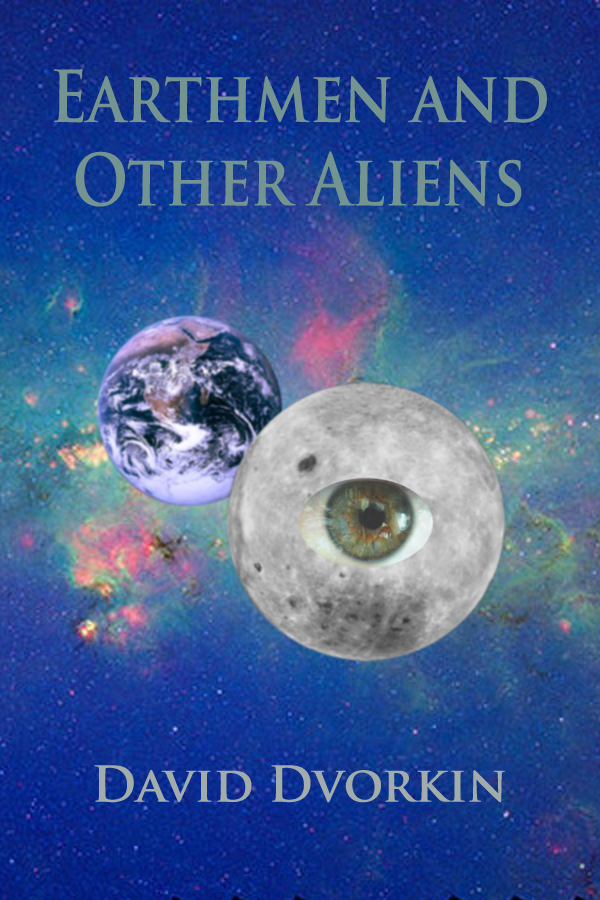
Earthmen and Other Aliens now available

On Amazon (Kindle) and Smashwords (various formats). Barnes & Noble, Sony, Apple, etc. should follow during the coming weeks, as Smashwords distributes to them. I’ve also submitted a PDF version to Google for their e-book store. That’s my first attempt at getting a book included there. If that one’s okay, I’ll start putting all of my others on Google, as well.

Links for ordering, the cover image, and a bit of info:

http://www.dvorkin.com/earthoal/

Monday, December 27, 2010

The Story of the Very, Very Earnest Black Swan

Black Swan is a very, very earnest movie about a very, very good but very, very mentally messed-up ballerina, played very, very earnestly by the usually very, very good Natalie Portman, who unfortunately isn’t quite on her toes for this one.

Portman’s character is given a chance at a career-making role, dancing both the white (very, very good) swan and the black (very, very bad) swan in an odd-sounding version of Swan Lake created by an egomaniacal choreographer (is that redundant?). Who is also very, very sleazy. And slimy.

However, she’s very, very repressed, so while she can dance the white swan with technical proficiency, she can’t let her inner black swan come out and be all evil and seductive on the stage. She also has to contend with a very, very domineering mother (well and creepily played by Barbara Hershey) and a very, very (very, very, very) hot rival (well and deliciously played by the very, very (very, very, very) hot Mila Kunis).

The rival has black wings tattooed on her back. Look! A symbol!

Portman’s character is a sick puppy. She has bizarre hallucinations, can’t separate dreams and fantasies from reality, scratches herself till she bleeds, and thinks there’s a real black swan inside her that, from time to time, comes out – e.g., black feathers poking out through the deep scratches she has inflicted on herself, her neck lengthening into a swan’s neck, black wings growing from her back. She wants to destroy the black swan inside her. She wants to liberate and become the black swan inside her. Everything ends messily.

This is psychodrama as filmed by very, very earnest young film students. The movie works so hard at being arty that it fails at being art. Or entertaining.

There is a fair amount of dancing. Unfortunately, it’s almost all scenes of Portman dancing. She’s a fine actress but only an amateur dancer.

There’s a lesbian sex scene, less than convincing, as is usual in movies, but elevated to hotness because Mila Kunis is in it. (Kunis has one of the few good lines in the movie, and she delivers it with verve.)

Don’t waste your time. If you want to see an entertaining dance movie, rent the delightful movie Center Stage, which starred actual professional dancers who turned out to be excellent actors. I think I need to watch that one again to wash away the black taste of swan crap.

Tuesday, December 07, 2010

Shrieking Zanies on My Screen

Shrieking zanies on my screen
Make this viewer want to scream,
Make this viewer want some booze.
Endless sports on the nightly news.

How they obsess over injuries.
Mangled elbows, damaged knees,
A ruined back or a shattered hip.
“These could cost us the championship!”

Other news is second rate
When compared to our team’s fate.
Wars and floods and all the rest
Matter not if our team’s best.

Skip the news. The weather, too.
Our team’s coach said something new!
Something stupid, something dumb.
There are no depths he cannot plumb.

Shrieking zanies want to claim
Insight into next week’s game.
Coach’s tactics, players plans,
Braindead mouthings from the fans.

I don’t learn the vital stuff.
Will the drive to work be tough?
Will the roads be wet or icy,
And the drive home tense and dicey?

Did the Dow Jones take a dive?
Is democracy still alive?
Has the Middle East exploded?
Have our rights still more eroded?

Might as well just change the name.
“Mindless babble about every game
“Every night on every station
“And that’s it for information!”

Sure, a title that is snappy
Makes a TV exec happy.
In any case, the fact remains:
Sportscast zombies want your brains.

Oh, if I were but in charge
The solid news I would enlarge
The sports “reporters” quickly fire
And proper journalists I’d hire.

No pretty faces mouthing fluff
Smirking at you, all that guff,
Endless babble, wasting time,
While repeating right-wing slime.

They’d all have brains and be well read,
With politics from pink to red.
They’d read the news and analyze.
They’d be Democracy’s prying eyes.

They’d tell the truth and pay no heed
To plutocrats and all their greed,
Their lawyers and their paid-for tools,
Their Limbaugh pigs and Coulter ghouls.

We’d know what’s what,
Who sold, who’s bought,
What deals were made,
What rights in trade.

All that would show
Upon your screen
In this sweet world
Of might-have-been.

But cash controls the info flows
And plutocrats know what to ban.
Once tumbrels rolled. Aristo knows
The danger of the thinking man.

And so they hire pretty critters
A stupid hunk, a vapid fox,
Who, sitting on their well-toned sitters,
Grin vainly from the idiot box.

Their voices loud, of dumbness proud,
They flirt and smirk and pose and preen.
And we are left of news bereft
With shrieking zanies on the screen.

Tuesday, November 23, 2010

Age, relative and absolute

By which I don’t mean “you’re as young as you feel” but rather how one perceives the ages of other people.

When I was somewhere around ten or eleven, I attended some sort of social gathering with people of all ages – most likely some Jewish community event. There was a group of young people there, all in their early twenties, gathered in a group and speaking in their secret generational language and flirting with each other.

I watched them in awe. They were so smooth, so sophisticated, so glamorous, so self-possessed, so in control of themselves and the world. I couldn’t wait to be in my early twenties so that I could be as smooth, etc. as they were!

I’m 67 and I’m still waiting, but never mind that. Now, of course, when I look at young people in their early twenties, I see just barely no longer kids, often trying awkwardly to be smooth, etc. It’s possible that young people in their early twenties now are dramatically different from young people in their early twenties 55+ years ago, but it’s much more likely that the change is in me.

We’ve all experienced this. Throughout most of our lives, “young” is anyone more than a few years, say 5 years, younger than ourselves, and “old” is anyone more than a similar number of years older than ourselves. Look at the photos in your high-school yearbook (You kids today do still have those, don’t you? Why, when I was a lad … ) and you’re astonished at how young and immature those kids look. You don’t remember them that way at all!

Nothing new there. But here’s the thing that’s changed for me. I don’t know when this happened, fairly recently I think, but lately that relative perception of age has given way to a more absolute one. The young aren’t getting younger as I grow older. They’re staying about the same. And “old” doesn’t mean X years older than me. “Old” is a category I’ve moved into myself. Or, on my more denial-of-reality days, am just about to start moving into myself.

I used to be aware of old people referring to themselves and their peers as old people, but that never struck me as odd because to me they were all old people. Now that I’m one myself, officially a senior citizen (What a silly phrase! What if I’d never become naturalized? Would I be a senior resident alien?), I’m speaking the same way.

It seems natural. Although when I think about it, it also seems strange, a bit unsettling.

Rather suddenly, people no longer occupy various positions along a spectrum from very young to very old, with “normal” referring to a narrow band of about 10 years width in the middle of which is yours truly. Now the world is divided into the young and the old, and I know quite well which of those two I’m in.

Sunday, November 14, 2010

Earthmen and Other Aliens

Years ago, an editor suggested that I put together a collection of my short stories. I thought it would be a rather skimpy collection, so I put the idea on hold.

This weekend, I decided to take a break from putting off writing Chains and see what stories I have. There are a few that have been published and a few more that should have been published. So, given that I’ve already leaped into the brave, new, revolutionary, world-changing environment of self-published e-books, which means that there’s no agent or editor to dump me if my sales numbers are disappointing, I’ve started putting together a short-story collection.

The title is Earthmen and Other Aliens, which is (almost) a line in one of the stories. I had originally thought to title it The Eye at the Back of the Moon, the title of one of the stories. I decided against that, but it did give me a cover idea.

It’s taking time because some of the stories were written on a (gasp!) manual (gasp!) typewriter and now have to be scanned in, and then the scanner’s OCR output has to be corrected. In the case of my first published story, I don’t even have a clean typed copy, only photocopied pages from the magazine. The scanner has been having a fun time making up words to match the marks on those faded pages.

There’s also one story I’ve been wanting to write for a while. I was waiting for a suitable market to appear, so that I could write the story, submit it, be rejected, and feel sorry for myself. I can skip some of those steps and just write the story. Which of course is the way it should work, aahtistically speaking. But that will take some time.

I hope to have the book up on Smashwords and Amazon in a week or two Or three. At most. I hope. Other outlets (B&N, Apple, Sony, etc.) will then follow as Smashwords distributes to them.

And I have a cover for it already:

http://www.dvorkin.com/earthoal/EarthmenOtherAliensCover.jpg

Tuesday, November 09, 2010

David Dvorkin, cover designer

I created a page to show all of the covers I’ve created for my e-books, my wife’s e-books, and a friend’s e-books.

Zowie! They look even spiffier when they’re all together like that.

Sunday, October 31, 2010

The Liberated Writer

Four years ago, I started this blog with a post explaining why I chose the name A Blister to My Eye. I said the function of the blog would be to pressure me to complete the time-travel novel, Time and the Soldier, that I had been fiddling with for ten years.

This evening, Leonore reread that original post and suggested that I post something about what’s happened with that novel and with my attitude toward my writing career.

I finished the novel a while ago. Two years ago, I think. All excited, and convinced that it was the book that would revive my professional writing career, I set about querying agents. I got an agent, a big name with a very big agency. He loved the book and sent it out to a number of editors. There were some rejections and a lot of non-decisions. And then he decided to leave the agenting business and become an editor at a major publishing house.

Realistically, that meant that Time and the Soldier was dead. Reputable agents aren’t interested in representing a book that has already been rejected by some of the editors they would want to send it to. The editors who hadn’t made a decision would be possibilities, but still the pool of possible editors would be too reduced.

So I stewed for a while and felt (very, very, very) sorry for myself for a while. Then I got fitfully to work on the next novel, Chains. I’d finish that, use it to get an agent, and then ask my new agent to rep Time and the Soldier as well. My professional writing career would be revived! Woo hoo!

I worked fitfully on Chains, hampered by self-pity, which was in turn increased by my being laid off in May 2009 and by my realization that there were no jobs to be had and I might never have a dependable pay check again.

While I was laid off, I spent some of my time reissuing my and Leonore’s previously published books as e-books. I found that I really enjoyed designing the covers for them. I had thought that would be a chore because I’ve never had an artistic eye or an eye for design, but thanks to Gimp and then Photoshop, I discovered that I did.

Well, that was fine for the old books, which would otherwise be unseen by the human eye. But Time and the Soldier was a new book and deserved real publication – i.e., a print edition, from a major publisher, that would show up in bookstores and on racks in supermarkets everywhere.

And then, quite recently, I realized that my attitude had changed. I was going to write, in this post, about how that evolution in my attitude happened, but the truth is that I don’t really know quite how it came about. After depression, and then anger, I suddenly came to feel detached from the industry at whose doors I had been hammering for decades.

For a brief time, early in my career, in the 1970s and early 1980s, those doors seemed to have opened for me. I seemed to be inside the room, albeit still standing near the door and looking at the happy crowd at the buffet table near the opposite wall. But some invisible barrier still blocked my way, and then a sinister and ineluctable force reopened the doors behind me and pushed me back out and locked the doors in my face. I.e., my career tanked.

So I was back to hammering at the doors, but the sound of my knocking couldn’t be heard within because of the loud voices of the happy crowd at the buffet table. Extend that metaphor if you really want to.

And then I stopped hammering.

Some time during the last year, the publishing industry became an alien thing to me, a noisy undertaking over there, a crowd of people standing in a field, waving their hands and shouting at each other and pushing and shoving, filled with desperation, trampling each other underfoot. Irrelevant, pointless, foolish, distasteful.

So I published Time and the Soldier as an e-book. I was pleased by my own lack of regret. The book that, for so many years, I had thought of as my ticket back into that room and maybe all the way to the buffet table would now float out there in the ether and be read by … a few dozen people, with luck. I liked that idea!

Then I realized that I was thinking of Chains not as the book that would be ubiquitous in a print edition and would revive my professional writing career but instead as my next e-book. It, too, would be read by a few dozen people if I was lucky. But what mattered was that my change in attitude about publishing changed my attitude toward how I was writing Chains.

I’m writing it exactly the way I want to write it. It may end up being very long. Or not. It will have a lot of dialog about many different subjects not related to the main plot. It will be discursive and recursive. It will have many points of view and will jump about between them. It will have characters ranting about this and that – political, social, and literary rants that will of course reflect my own attitudes. I’m already enjoying writing Chains more than I’ve enjoyed writing a book in a long time. It’s a wonderful feeling of artistic liberation.

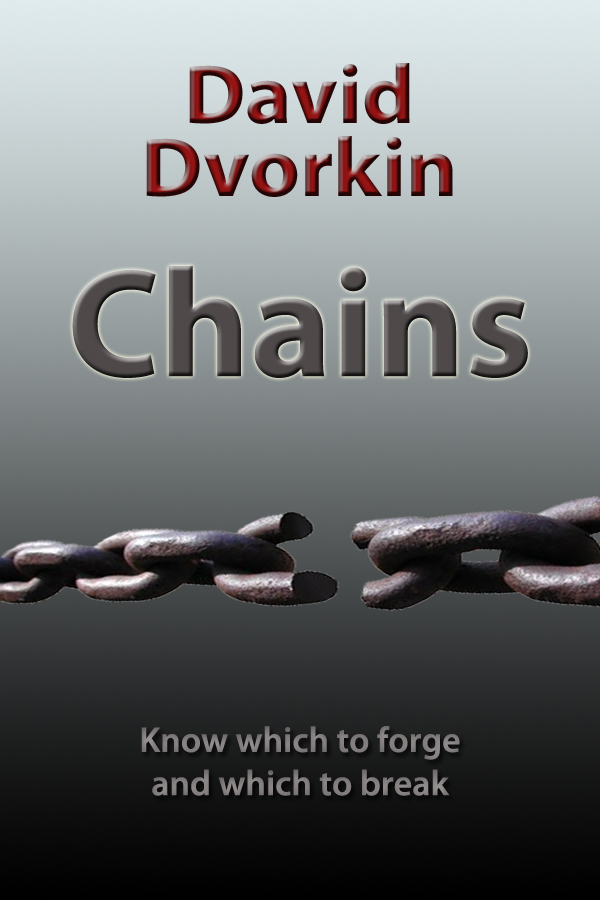
I’ve already created the cover for Chains, and it’s pretty damned zowie, if I do say so myself, and I do. There’ll be other books after Chains, all of them with zowie covers. There’ll be a collection of short stories, a horror novel, a fantasy novel, and, and, and ...

I’m a writer again! And it feels great.

Thursday, October 21, 2010

The perfect job!

I just got this in e-mail. Name of supposed sender has been replaced by XXX just in case it’s a real person.

Who could resist this offer?

For ,

I'm XXX. I am personnel managr of our Company.
Our department noticed your CV on Jo.b site ,
Our department sure u're fit for the position
of Financial manager.

For more info concerning available j.ob.


This may be the perfect complement to your current
jo.b.

If u're want to start, contact me for the next step
of the process.

With respect

Tuesday, October 19, 2010

Time and the Soldier e-book

Did I not post about this here? Apparently not. What a shocking oversight!

After much sturm und drang and up and down and elation and depression and … you get the picture. After months and years of all of that, I came to a writing-career decision that, for me, was very, very major. Namely, no more with the agents and editors and publishing companies. Embrace the e-book revolution, I told myself. So I published Time and the Soldier as an e-book, putting aside all thoughts of seeing it published physically, let alone seeing it on the racks in the local supermarket.

Which is also to say, I self-published it. Better than having it gather virtual dust on my hard drive, unread by anyone else. It may only be read by a few other people, but that’s still a few more than would read it if it never left my PC. And it will be around and available for purchase forever, or at least for a very long time.

And it has a very spiffy cover, which I created myself via the magic of Photoshop.

Details, including links to buy it in Kindle and various other formats, here: http://www.dvorkin.com/timsol

Too bad I’m not a famous blogger. The book would be virtually flying off the virtual shelves within seconds after I post this.

Monday, October 04, 2010

How We Became Breast Cancer Thrivers

This is a new free ebook. It’s a collection of essays by breast cancer survivors who have a positive attitude about their experience with the disease. Leonore is one of the contributors; her piece is on pages 73-70.

The book was edited by Beverly Vote, who publishes The Breast Cancer Wellness Magazine. You can read about the book on our Web site or on the magazine’s site. If you go to the magazine’s site, click on the link titled “Download E-Book” in small print to the right of the cover image. That opens the PDF version of the book, which is much easier to read than the digital version that the “View Now” link takes you to.

Monday, September 27, 2010

Sniffle, sniffle

I just saw the following announcement of a short story sale. Names disguised to protect them. And possibly me.

Xxx has a narrative poem, “xxx,” in Xxxxx, an anthology of stories around why women are blamed for everything. The book is edited by Xxx and available on Amazon and other venues.

Monday, August 30, 2010

As We Know It

“If we don’t act now, civilization, AS WE KNOW IT, will be destroyed.”

“If we don’t stop this asteroid, it will mean the end of LIFE AS WE KNOW IT"!”

But civilization/life as we don’t know it will be fine?

I really hate that kind of meaningless, reflexive verbiage. It gets added to proclamations, I think because the speaker has heard it so often that he thinks it’s necessary, even though it adds nothing to his statement. Or else because he’s a kneejerk twit.

There are other examples. After Nixon used the phrase “at this point in time”, perhaps during the Watergate crisis, everyone started saying “at this point in time” when they meant “now". Now, damn it, now!

Nixon was the first person I heard say, “I misspoke myself,” instead of, “I was mistaken,” or “I am a pile-of-shit, amoral, soulless, lying crook.” After that, other speakers started using that phrase. Which is okay if you’re a pile-of-shit, amoral, soulless, lying crook. If not, you should probably avoid it and just say something like, “Sorry, I spoke carelessly.”

The first person I heard say “with all due respect” was Jimmy Carter. It was during one of the presidential debates, either in 1976 when he was debating the silly but not evil Gerald Ford or in 1980 when he was debating the Good-God-what-an-evil-pile-of-stupid-shit Ronald Reagan. If I weren’t so old and if I hadn’t drunk so much bourbon, perhaps I’d remember which it was. Not that it matters. Silly but not evil on one hand. Evil pile of stupid shit on the other. Or Republican presidential nominee, for brevity’s sake.

(I think it was 1976, and I think it was in response to Ford clumsily misspeaking himself at that point in time about how East Germans or Poles saw themselves in relation to the Soviet Union. As we knew it.)

I remember being astonished at Carter’s using that phrase. Respect? I thought. For that gray space on the podium? Are you kidding? What respect could you, a highly intelligent, technically educated, well spoken man possibly have for that creature? Why did Carter say it? Was he trying, kindly, to soften the blow before demonstrating how brain dead the Republican was?

Why bother? If you don’t respect the other guy’s opinion, don’t bother with the empty phrase “with all due respect”. If you’re predicting the end of the world, then predict it; don’t add excess words like “as we know it”. If you’re a Democratic candidate debating your opponent, just say, “You’re an astonishingly stupid pile of evil shit, and the policies you propose would destroy civilization. You need to be shut away in a loony bin right now. Jerk.”

Sunday, August 22, 2010

David’s Definitions for October 2010

Bromidic

An adjective describing platitudes, trite sayings, clichés. A person who constantly utters such stuff can also be called bromidic. This describes a lot of politicians and speakers at graduations. In the great musical "South Pacific," Nellie Forbush describes herself as bromidic - boring, ordinary, and "a cliché coming true." The adjective bromidic comes from the noun bromide, which refers to such platitudes and clichés. A person who tends to utter bromides can also be called a bromide. In turn, bromide comes from chemistry. Yes, chemistry! Not because chemistry is a cliche, but because a bromide is a compound of the element bromine and some other element, and 100 years ago, certain bromides, in particular potassium bromide, also called bromide of potassium, were commonly used as sedatives. Hence bromide came to mean something that puts you to sleep - like the typical graduation speech. Interestingly, the element bromine, where all of this started, has a very pungent smell, and the name bromine comes from a Greek word that refers to the stench of billy goats, which is not something that any of us would consider bromidic.

(Will be published in the October 2010 issue of Denver's Community News.)

The Scrabble word score of bromidic is 15.
You can find that out here:
http://www.dvorkin.com/scrabscor.html

I'm collecting all of these at:
http://www.dvorkin.com/davidsdefs.html

Fascinating Word Facts

Did you know that:

The words "race car" spelled backwards still spell "race car"?

"Eat" is the only word that, if you take the first letter and move it to the last, spells its past tense, "ate."

And if you rearrange the letters in "Tea Party Republicans," and add just a few more letters, it spells: "Shut the fuck up, you free-loading, progress-blocking, benefit-grabbing, resource-sucking, violent, hypocritical douche bags, and deal with the fact that you nearly wrecked the country under Bush and that our President is black, so get used to it."

Isn't that interesting?

Thursday, July 22, 2010

David’s Definitions for September 2010

Senile

Nowadays, we use this word to mean old and infirm, weak from old age. This usage dates from the mid-19th century. Originally, the word just meant having to do with old age. It comes from a Latin word meaning old. Other words that derive from the same Latin root are senior, senescent (growing old, characteristic of being old), and the Spanish title señor. The medieval English word seneschal, a senior servant, comes from the same root combined with a Germanic word, skalk, for servant. I haven't been able to find out if skalk has any connection to our word skulk, which can mean to evade work. Presumably, one of the duties of the seneschal was to make sure that the lower-level servants didn't skulk.

(Will be published in the September 2010 issue of Denver's Community News.)


The Scrabble word score of senile is 6.
You can find that out here:
http://www.dvorkin.com/scrabscor.html

I'm collecting all of these at:
http://www.dvorkin.com/davidsdefs.html

Tuesday, June 22, 2010

David’s Definitions for August 2010

Risible

Laughable, but in a negative sense. You wouldn't call a comedian's jokes risible if you liked them. If he was a painfully bad comedian, you could say that his attempt at comedy was risible. This is not a common word in modern English. It usually only shows up in pompously written book or movie reviews or political essays - the sort of thing written by people who can't see that their stuffy prose isn't admirable but is instead risible. The word appeared in English in the 1500s. Back then, it meant able to laugh, capable of laughing. By the 1700s, it had come to mean evoking laughter, laughable, but it didn't have a negative connotation yet. That's more modern. The root is the Latin word ridere, to laugh. Our word "deride" comes from the Latin combination de (down) combined with ridere. Someone who uses "risible" in ordinary speech is likely to encounter derision.

(Will be published in the August 2010 issue of Denver's Community News.)

I'm collecting all of these at:
http://www.dvorkin.com/davidsdefs.html

Saturday, June 19, 2010

But doctors urge caution blah blah alcohol blah blah

Last night, TV news carried yet another story about the benefits of alcohol. This one concerned the new Dutch report of a correlation between moderate alcohol consumption and reduced risk of several types of arthritis.

After the teaser for that news item, I said to Leonore, “I bet they’ll quote doctors warning people solemnly about the dangers of alcohol.” Of course I was right. Doctors caution against blah blah blah. Because of course if they didn’t give us those warnings, we’d all rush out and drink ourselves into the gutter and divorce and bank robbery and liver failure.

I’ve seen articles about the benefits of tea and coffee, and those lacked solemn warnings against taking up tea and coffee drinking. Yet historically tea and coffee houses have led to far more revolution than alcohol ever did. Possibly to more social unrest and planning of bank robberies, too, but I lack solid data regarding those.

Only when it concerns alcohol does the medical establishment – or maybe it’s the medical journalism establishment – feel the need to moralize, the conviction that without their stewardship we’d all go to Hell. Twits.

Sunday, June 13, 2010

Great review of Dawn Crescent

The book was published a few years ago, but this review seems to have just shown up on the Joe Bob Briggs Web site.

I’ve just reissued the book as an e-book via Smashwords, so I hope this will do some good.

Tuesday, June 08, 2010

Forgive my indignation

Latest version of the Nigerian scam came in e-mail today:

Compliments of the season

Forgive my indignation if this message comes to you as a surprise and may offend your personality for contacting you without your prior consent and writing through this channel. When I was searching for a foreign reliable partner I assured of your capability and reliability to champion this business opportunity. I Request you to partner with me in order to finish a transaction worth 18,500.000.00 USD and transfer from here to your country. Your share would be 30% of the mentioned amount above. If you are interested, then reply me with your Full Names,Address,Age,Occupation,Phone,fax/nofor instructions :

Monday, June 07, 2010

Interview version of the school dream

I have a phone interview scheduled for this afternoon. Last night, I dreamed that I had decided to call it off. No idea why; it’s one of those things that make sense inside the dream.

Because Leonore and I were planning to go for a walk, and because the company was located near our house (in the dream, not in the real world), I said let’s just walk over there and I’ll cancel the interview and not bother calling or e-mailing to do it. We left the house with me wearing jeans, a t-shirt, and flip-flops with white socks. Yes, the socks made that uncomfortable. Leonore said, “Maybe you should wear business clothes, just in case someone there wants to talk to you.” I said, “Nah, I’ll just tell the receptionist.”

The actual company is small and headquartered here. The dream version was a minor branch of an international giant. Fancy waiting room full of suited people filling out application forms. I identified myself to the receptionist, who immediately pulled out a bunch of forms for me to fill in and said that as long as I was there, they’d just do the interview in person.

Cowed, I said nothing, went to a seat between two men in suits and ties, and started filling out the application form. Leonore was right, I thought. I should have worn business clothes.

It was really cold in there, too.

And then the dream ended. I bet I got an F in the course.

Saturday, May 22, 2010

David’s Definitions for July 2010

Effect, Affect

A reader asked me to define these two words and explain how to use them. They're closely related words, very similarly spelled and pronounced, so it's easy to see why people get them confused. Affect is the verb, the action word. "The tragic story affected him deeply." Effect is the result. It's the noun, the thing. "The tragic story had a powerful effect on him." Perhaps it would help to think of the word effective. Something is effective if it has an effect. Unfortunately, and to make things more confusing, there are a couple of cases where the situation is reversed.  Effect does have one use as a verb: to bring something about, to cause something to happen. "The prisoner effected his escape by jumping from the police car." And affect has one use as a noun, meaning one's mental state. Fortunately, both of these uses are rare in ordinary English. Affect can also be used as a verb in the sense of "pretend": "He affected an air of cynicism." I think that use is rather old fashioned, though. I hope the effect of all of this is to leave you less confused, rather than more.

(Will be published in the July 2010 issue of Denver's Community News.)

I'm collecting all of these at:
http://www.dvorkin.com/davidsdefs.html

Tuesday, May 18, 2010

Vile

I think vile is becoming one of my favorite words.

It so perfectly describes the moral foundation of certain movies – e.g., The English Patient, Like Water for Chocolate – and political movements like the Tea Bagger idiots and the contemporary Republican Party.

Then there are the Promise Keepers and the Dominionists. Vile.

The National Rifle Association. Vile.

Free Republic. Vile.

No doubt the list could be a lot longer.

And of course the word is an anagram for evil. Coincidence? Yeah, right.

Saturday, May 01, 2010

Second Smashwords book

Business Secrets from the Stars, which is currently available in trade paperback and hardcover from Norilana Press, but not in e-book form. I’ve put it up on SW:

https://www.smashwords.com/books/view/14043

I’m really pleased with the cover I created. Click on the image for a big version.

Monday, April 26, 2010

Pit Planet Smashworded

I put one of my old novels on Smashwords as an e-book. This one didn’t take long to do. I guess I’m getting faster at this. Formatted the text, designed the cover, zippity zip. It’s here:

http://www.smashwords.com/books/view/13760

Sunday, April 25, 2010

Smashwords

I like saying that. Smashwords. Smashwords!

We just issued Leonore’s novel, Apart from You, in e-book format via Smashwords. (Smashwords!) The link is:

http://www.smashwords.com/books/view/13715

Smashwords! Or did I already say that?

I’m going to start getting all of my old books out as e-books the same way. Namely, via Smashwords. (Smashwords!) I’m thinking of completing my vampire series as e-books. Two were published in mass-market paperback, eons ago, but I had plans for two more, which I’ll probably write, this time around. Similarly, my one real mystery novel was supposed to be first of three novels featuring the same (somewhat anti-)hero, so maybe I’ll do that complete series now.

Via (all together now) Smashwords!

(Smashwords!)

Tuesday, April 20, 2010

Gloob died today

It was an incalculable loss to mankind. He was the last of his people, the Gleb, and the last speaker of their language, Glebbish. Gloob leaves behind a cultural and spiritual void of immeasurable dimensions. At their peak, the Gleb spread across two square miles of virgin rainforest. Their language contained at least 24 distinct nouns describing the shape of the leaves of the Wakawaka tree, and each of those nouns had its own declension. With Gloob, not only did that unique linguistic heritage die, but so too did the the deep, spiritual relationship between the Gleb and the Wakawaka tree. A special way of seeing Wakawaka leaves has vanished. Our planet is impoverished by his passing.

And so on and so forth, blah blah fuckety blah. How many times have you seen this shit? The last speaker of a very minor language dies, the last repository of a very minor and very primitive culture dies, and a certain portion of the human race goes into paroxysms of grief and pontification.

Did you know Gloob? Were you affected by his death? Was anyone you know affected by his death? Has the vast engine of industrial civilization paused for the slightest fraction of a second to acknowledge it?

Did you know anything about the 24 (at least!) distinct Gloob nouns for the shape of the leaves of the Wakawaka tree, and their 24 (at least!) different declensions? Has their loss impoverished your usage of English? Do you give a shit? Other than linguists, does anyone who didn’t know Gloob care?

Gloob may have been a wonderful chap. His death may be a lasting sorrow to those who knew him. But in spite of the leaves of the Wakawaka tree, the effects of his death don’t extend beyond his immediate circle. Or perhaps Gloob was a rotten son of a bitch and everyone who ever came in contact with him is celebrating his death. The pontifications will be the same in either case.

There’s a good chance that while you were reading this a very good man died somewhere, causing lasting grief to those who loved him. Let’s call him John. Unless John was a major world leader, odds are you’ll never know about him or his death or the sorrow it caused. John’s death will have no effect beyond his immediate circle. Most likely, John was a speaker of English or Mandarin or Spanish or Arabic. His death will have no effect on those languages or world culture or our relationship to the Wakawaka tree. The only difference between John and Gloob is that no self-important bloviators will pontificate about how John’s death diminishes us all.

David’s Definitions for June 2010

Travail

Hard work, especially painful or extremely unpleasant work. It used to also refer to the painful experience of giving birth. It comes from the old French word travailler, which could mean to work hard or to torture. In turn, that came from the Latin word trepaliare, to torture. In case you care, that Latin word came from the Latin word tripalium, a three-pronged instrument of torture, which in turn came from the Latin tri, three, and palus, stake. We get our world pole from that last Latin word. Think of all of this when the alarm goes off tomorrow morning. By the way, you might suspect that our word travel also comes from the French word travailler, because they look so similar. Indeed it does. Travel showed up in English in the 1300s, a time when traveling was a pretty arduous and dangerous undertaking. At least they didn't have alarm clocks, although some of those old English travelers must have fantasized about torturing the roosters that woke them up.

(Will be published in the June 2010 issue of Denver's Community News.)

I'm collecting all of these at:
http://www.dvorkin.com/davidsdefs.html

Saturday, March 20, 2010

David’s Definitions for May 2010

Pilot

In modern usage, this almost always means a person who controls the flight of an airplane. We also use it as a verb: To pilot a plane. The word first appeared in English in the early 1500s, and originally it referred to the person who controls the direction of a ship. In the 1800s, it came to mean the person who controls a balloon. It didn't take on the airplane meaning until the early 20th century. It stems from a Greek word, pedon, meaning "steering oar." That word is related to the Greek word pous, "a foot." So pilot is distantly related to octopus ("eight-footed") and podiatrist (someone who treats ailments of the feet). At one time, podiatrists treated ailments of the hands as well and were called chiropodists, from the Greek word for hand, chiro, combined with the Greek word for foot. A related word is chiropractor, combining the Greek word for hand and the Greek word praktikos, "practical." Which brings us back to pilot, because after you spend a few hours crammed into a modern airline seat, you need a chiropractor to straighten you out again.

(Will be published in the May 2010 issue of Denver's Community News.)

I'm collecting all of these at:
http://www.dvorkin.com/davidsdefs.html

Monday, March 15, 2010

I don’t have a criminal record

Sometimes, waiting for a response to job applications, I have this irrational fear that some guy with the same name as me has a criminal record, which shows up when potential employers do a routine check. But I'll never know. So I should think about other things and not let myself go crazy. That's what the giant, fanged rabbit keeps telling me. He says I should worry instead about the coming end of the world.

Saturday, March 13, 2010

Coffee Party

I just went to a local Coffee Party meeting and left before it ended. Too weak, too diluted, too much emphasis on holding hands and playing nice and working together. It's not left or right, Republican or Democratic, not an answer to the Tea Party. It's just lots of good intentions and optimism.

Also, despite the lip service to the organization being grass roots and bottom up, the whole event was predetermined and dominated by the moderator and his script, which parroted what's on the Coffee Party Web site.

I want an organization that will tap into and represent the anger of the left. I don't know if such an organization would have a political impact, but I don't think the Coffee Party will, either.

Friday, March 05, 2010

Ghastly executions and cheering crowds

But not in movies. For some reason, with the occasional exception of Westerns, Hollywood likes to portray the crowds attending grisly public executions as being horrified by what they’re watching and filled with sympathy for the prisoner.

I’m pretty sure I remember the protracted, gruesome execution of William Wallace being depicted that way in the terrible Mel Gibson movie (or is that redundant?) Braveheart. I’m quite sure I remember the execution of Guy Fawkes being depicted that way in the movie V for Vendetta.

I suspect that in reality, in both cases the crowd was cheering on the executioners. After all, the crowd knew what to expect in such executions, and if they found the drawn-out torture and death of a prisoner so repulsive, they probably wouldn’t have attended. It’s my understanding that public executions in England, and probably elsewhere, were considered wonderful spectacles, and people went there to be entertained by the awful suffering and exposed viscera of the condemned.

Moreover, Wallace was not a hero to the English. In their eyes, he was “an outlaw, a murderer, the perpetrator of atrocities and a traitor” – an accurate view, given his violent, destructive raids into (civilian!) England. Nor was Fawkes a champion of liberty and opponent of royal tyranny as implied by that entertaining but fundamentally silly movie. Had the Gunpowder Plot succeeded, many innocent people would have died along with the targeted ruling class, and the country would have been plunged into chaos. That chaos, the plotters hoped, would have been followed by the institution of a Catholic monarchy that would have been far more repressive than the rule of James I. So the crowd was probably very happy to see Fawkes being slowly dispatched.

In fact, I suspect that there were many older people in the crowd who were disgusted. I can imagine one of them saying, “These executioners, they’re going to make that fellow die too quickly. He’s not going to suffer anywhere near enough. Why, when I was a lad, torturers and executioners really knew their business. They could draw it out for days, I’m telling you. Ah, well, what can you expect? These are evil and declining days, and the country’s going to the dogs. Dogs! Did I ever tell you about the time I saw a man torn apart by a pack of hungry dogs? That was back in the good old days.”

Friday, February 26, 2010

Enlarged prostate

That’s the sort of thing one thinks about more often, as one gets older. At least, if one is a oner and not a oness.

A few years ago, I read that 50% of men aged 50 have an enlarged prostate. (How enlarged? The article didn’t say.) Or benign prostatic hyperplasia, BPH, which sounds so much less scary. Or possibly more.

The same article said that the rate increases to 60% at age 60. And 70% at age 70. It’s linear!

Surely those numbers were rounded off. My father is almost 101, so I have some hopes of living at least that long myself. Does that mean that I can be 100% sure of having BPH at age 100?

And what happens after that? If every man age 100 or over has BPH, then in order for that line on the graph to continue upward linearly (which of course it has to do because that’s the way it worked in the old science fiction stories I read as a kid, and those are the source for my understanding of the workings of the Universe), then old women would have to start getting BPH, too, which is of course impossible.

Perhaps after age 100, the line suddenly turns downward. If you make it past 100, your prostate starts to shrink again! (I could ask my father, but I hate to give him another reason to talk to me about his prostate gland.)

I can imagine a conversation between an old guy and his doctor.

Doctor: Joe, I have good news and bad news for you.

Joe: What’s the bad news?

Doctor: Those problems you have urinating, it’s because you have BPH. (Explains what that is.) And it’s going to keep getting worse.

Joe: Well, that’s a pisser. Not. What’s the good news?

Doctor: You’re 90 years old. If you can make it for another ten years, your prostate is going to start shrinking again.

Joe: That’s good news? All I have to do is hang on for ten years, and I’ll be able to pee again?

Tuesday, February 23, 2010

David’s Definitions for April 2010

At Loggerheads

When people are at loggerheads, they are in conflict and unable to agree. The origin of the phrase is apparently unclear. In 16th-century England, a loggerhead was a heavy block of wood to which horses were tethered to keep them from wandering away. In those days, loggerhead also meant a stupid person, a blockhead. In the next century, a certain kind of heavy iron tool was also called a loggerhead. The assumption is that people who were in conflict were said to be at loggerheads because the conflict makes one think of fighting with such dangerous items. The original meaning of loggerhead survives in the name of the loggerhead turtle, which is named that because of its unusually large head.

(Will be published in the April 2010 issue of Denver's Community News.)

I'm collecting all of these (but I’m way behind) at:
http://www.dvorkin.com/davidsdefs.html

Unclose shave at the Olympics

A couple of years ago, I wrote a blog post complaining about the stupid stubble look on men. Three-day whiskers. The absurd Miami Vice look, made popular by a TV show that’s probably unknown to the young men who are forgetting to shave in this century. Some older men, too, for God’s sake.

As is always the case, an incisive post on my blog somehow failed to change the world. And now, two years later, scraggly whiskers abound at the Winter Olympics in Vancouver, an otherwise beautiful city. Okay, the female athletes are still beautiful. It’s the men who all look like Skid Row bums.

I tell ya, thanks to the overly flamboyant costumes, we can even see that some of the male figure skaters and ice dancers have more hair on their chins than their chests.

As for the skiers, someone ought to tell them that a clean shave might shave a hundredth of a second off their downhill times. I have no idea if that’s true, but someone ought to tell them that, anyway.

Thursday, February 18, 2010

Spam comments

What's with spam comments on blogs?

This blog gets a lot of commercial spam in the comments section. I also see generic comments that say something like "Thanks for the info. I'd like to read more about this topic." That one shows up on other blogs, as well. It's strange, and of course very annoying and cluttering.

Monday, January 25, 2010

The Very Lucky Executive

There was this man named Hova. Jeremy. He was a remarkably lucky guy.

First, he was lucky enough to get a job in awful times. Second, despite lacking any ability, he was lucky enough to be promoted quickly, eventually becoming president of the company. That’s not unusual. It’s even fairly common. Some people just seem to make a good impression. But Jerry wasn’t particularly intelligent or good looking. He lacked charisma and, truth be told, was often unpleasant to be around. He was just lucky.

But all of that’s nothing compared to the run of luck Jerry had next.

Jerry chose a seaside location for his company’s new factory and the adjacent giant apartment complex housing the workers. He was warned that the site was on an active earthquake fault and next to an active volcano, but he brushed that aside. A year later, the factory was up and running and the apartment complex was filled with the workers and their families. Pats on the back from the Board of Directors for Jerry, plus a bonus. Then a massive earthquake struck. And a huge volcanic eruption. Followed by a tsunami. The factory was eliminated. Coincidentally, so were the workers and their families.

The Board met in emergency session to praise Jerry and beg him to save the company. Utterly irrational of them, of course, but I told you he was a lucky guy. The Board was convinced that what had happened was part of some large, brilliant plan of Jerry’s, and they were sure that they simply weren’t intelligent enough to understand what he was doing. It was best to let him press on and not interfere with him.

Jerry decided to shift the company’s emphasis to agribusiness. He had his eye on vast tracts of land in a third-world country that would be perfect. Unfortunately, the land was already occupied by some peasants who refused to move. So Jerry used corporate funds to set up and arm a fake rebel movement that drove the peasants away. Well, the few who survived were driven away. The others became involuntary fertilizer for the company’s new agricultural products. The Board applauded Jerry for his innovative thinking and awarded him another bonus. Crops were bountiful, and soon company-branded edibles were flooding markets in the developed world. Unfortunately, previously unknown deadly viruses and bacteria and parasites flooded in with them. Soon bodies filled the streets and highrises of London, Paris, New York, etc.

Once again, the Board met in emergency session to praise Jerry and beg him to save them. If anything, they admired the opacity of his brilliance all the more.

And so it went, year after year, decade after decade. Board members came and went, but Jerry stayed on, constantly making dreadful mistakes that cost huge numbers of lives, constantly being praised and rewarded for his work. It was a wonder that the company survived, and yet in fact it thrived. It became the largest, richest, most powerful corporation on Earth, possibly the most powerful entity of any kind. Jerry’s judgment and wisdom and foresight became the stuff of legends. Sometimes, one person or one small piece of equipment managed to survive one of these Jerry-induced disasters. This was seen as all the proof anyone needed of Jerry’s careful planning and deep compassion.

The next step was obvious: President of the World. Jerry’s making plans for that right now.

What a lucky guy! Wouldn’t you like to be as lucky as J. Hova?

Sunday, January 24, 2010

David’s Definitions for March 2010

Ironic

When used to refer to an event, it means contrary to what's expected, in a striking or poignant or tragic way. It derives from a Greek word meaning "to lie" or "to be insincere." Here's an example of irony: "The speaker, who was famous for his command of the English language, clearly didn't know the difference between ironically and coincidentally." People do often confuse those two words. Here's an example of coincidence, with nothing ironic about it: "The speaker had a third cousin named Hepzibah. So did the man who introduced him." There's nothing about this coincidence that is strikingly contrary to what you expect, so it's not ironic.

(Will be published in the March 2010 issue of Denver's Community News.)

I'm collecting all of these (but I’m way behind) at:
http://www.dvorkin.com/davidsdefs.html

Tuesday, January 05, 2010

Avatar made me blue

Because I wasted time and money watching it.

Mind you, it’s not because of the movie’s pinko, liberal, anti-imperialist, fuzzy-minded, bleeding-heart, liberal, tree-hugger message. I’m a pinko, liberal, anti-imperialist, etc. myself. I’m part of this movie’s natural audience. And yet I hated it.

Basic story: Alien world has mineral Earth badly wants and needs. Human beings set about strip mining the place. World’s inhabitants, ten-foot tall blue aliens with tails, are upset. Humans create their own ten-foot tall blue aliens with tails, telepathically controlled by humans and called avatars, to deal with the aliens. Our hero, one of those telepathic controllers, ends up preferring being an alien, switches sides, and leads a successful alien revolt.

Not wanting to wear the special glasses, we decided to skip the 3-D version and watch it in 2-D. I accepted that it wouldn’t be as visually interesting in 2-D, but I didn’t expect all of the characters to be two-dimensional. I don’t think the special glasses would have helped with that. I don’t mind good guys vs. bad guys, and I always prefer it when the good guys end up winning. But it helps when both good and bad guys are also real people, with believable motivations and human characteristics.

Speaking of which, the Simpsons are more human and believable than Avatar’s CGI aliens and their world. Hell, the actors in rubber suits and the papier-mâché rocks on the original Star Trek TV show (the only real Star Trek TV show!) were more believable than Avatar’s aliens and their world. For all the high tech and big bucks, the blue aliens and their lush world are a cartoon from beginning to end. I never believed any of it.

Details bothered me. For instance, the aliens we see the most of live in a giant tree. But their feet are flat and inflexible, with short toes, just like ours. The movie makers didn’t think about what the aliens’ feet should have looked like. They just copied human feet. Big budget for CGI, but small budget for thinking.

Don’t assume that I’m an elitist snob who normally prefers serious movies that delve into the human condition and were made in France. I avoid such movies like the plague. I insist on escape. Science fiction, fantasy, horror, comedy, and preferably a few good explosions and shootouts – that’s what draws me to the theater. I was looking forward to escaping into the alien world of Avatar. I tried hard for the movie’s full 18 hours but never succeeded.

The plot is clichéd and predictable from one scene to the next. The action scenes are devoid of tension. Not only are they cartoonish, they’re dull cartoonish. Think of the absurdity of the truck-freeway-jet-fighter segment in the last Die Hard movie, and replace Bruce Willis and the truck and the freeway and the jet fighter with cartoon blue aliens and flying lizards and humans in armed flying machines. Character deaths are predictable and devoid of emotion, and character escapes from peril violate both physics and physiology.

The relationships are passionless. We are expected to believe in them, but the actors, whether human or CGId into aliens, give us no reason to do so.

The alien society is an awkward mix of generic tribal American Indian and generic tribal African. This is symbolism of shameless nakedness. It punches us in the mouth and orders us to feel guilty for the sins of European and American expansion.

The aliens’ embarrassingly silly Earth-mother religion is glossed over with a pretense of science that is as unconvincing as the aliens themselves. They are deeply in tune with their world (take that, you urbanized, industrialized EuroAmericans!), but that doesn’t stop them from murdering peaceful herbivores for food, even though they’re surrounded by a bountiful forest with plentiful and delicious fruit. Okay, so they say mystical garbage to the herbivores before they finish them off. Big deal. The herbivore, gasping in agony from the arrow our hero has shot into him in one scene, might be wondering why the blue chap is now sticking a humongous knife into him. “In the name of the earth mother,” the herbivore might be thinking, “why aren’t you a vegetarian?”

In the end, the good guys win and the bad guys lose. But the bad guys are the empire, with its vast resources and advanced technology, especially ways of blowing things up real good, whereas the good guys are just primitive blue aliens. In real history, empires often lose such first skirmishes due to underestimating the primitives and the terrain and the logistics. Empires learn from these failures and return with overwhelming force. That’s why I’m writing this in a Western language, using Western technology, while living in what used to be land occupied by non-Westerners.

So in reality, the blue aliens would lose in the long run. If they were lucky, they’d end up on reservations. If not, they’d be eliminated. Either way, the end result would be the strip mining of the planet.

Or perhaps the aliens will accept the inevitable and make a deal with the mining company. They’ll grant mining concessions to the humans, and in return they’ll be given human weapons, which they will use to conquer and enslave the other clans of aliens whom we glimpse at the end of the movie. We’ve already seen that these simple, gentle, loving, living-in-harmony-with-nature aliens have a warrior caste and a warrior ethos. Hmm. Where did those guys come from?

Sunday, January 03, 2010

Mirror malfunctions

We’ve lived in this house for just over 38 years, and in general it’s held up fairly well. However, I’ve become increasingly aware that the mirrors are deteriorating. It’s not just the few remaining original mirrors either. There’s something in the house that seems to have damaged the newer ones, as well.

When we moved in, the mirrors showed me the man I expected to see. But increasingly, the degraded surfaces have distorted my image, giving me sagging jowls and wrinkled skin, and they seem unable to reflect my full head of hair.

I’m also becoming disenchanted with digital cameras. When we first switched to them, I thought they were a huge improvement over the old kind, with the bother of loading film and getting it developed and printed. But when I look at the pictures we took of me with those old gadgets and compare them to the pictures taken of me with our digital cameras, the difference is shocking. It’s a lot like the problem with the mirrors.

On the bright side, CGI keeps improving. Maybe that will provide the solution to both of these technological problems.

Wednesday, December 23, 2009

David’s Definitions for February 2010

Hapless

Unfortunate, luckless, unlucky. It comes from an old word, hap, which originally meant luck or chance and then later came to mean good luck. We don't use hapless in modern English, but we do use other words that come from the same root. For example, happen was originally happenen and it meant "occur by hap." If you're happy, you possess hap, good fortune. Haphazard, meaning irregular or disordered, comes from combining hap with hazard, which was a game played with dice.

(Will be published in the February 2010 issue of Denver's Community News.)

I'm collecting all of these at:
http://www.dvorkin.com/davidsdefs.html

Thursday, December 17, 2009

WIPing along, again

I’ve been working fairly steadily on the Work In Progress, working title Chains, as you can see from the graph on the right.

The stepwise nature of the graph isn’t what I’d like to see. The steps are the result of long periods of little or no productivity, until recently. It would be great if the line on the graph were fairly straight and at a 45 degree angle – or even better, around 60 degrees.

Better than flatlining, though.

Saturday, December 12, 2009

This here’s Winkel’s town, pahdnah

And don’t yew fergit it.

When I was a boy (traditional opening of stories told by old guys), my family moved from South Africa to the US. We didn’t stay here long, that time, but it was long enough for me to watch every cowboy show I could on TV and every cowboy movie I could in the theaters. At that time, there were a lot of both.

Then we moved back to South Africa. I was 10 at this point. We moved to a town named Rustenburg in the Transvaal, the deepest depths of the Afrikaner homeland, an area that had played a huge role in Boer history. Afrikaners in those days felt that there was considerable similarity between their ancestors of Great Trek days and the Americans who settled the Wild West, and the local library had a huge collection of cowboy novels. (No one called them Westerns in those days.) I devoured them all.

Rustenburg was a small town then, with one main street, which had lots of small shops owned by individual proprietors. (Yes, this was during Apartheid, so those were white shops, for use by whites only. At 10, I wasn’t aware of any of that.) The main street was paved, but because of the sun, there was a wooden canopy over the sidewalk, supported by posts. It looked a lot like the main streets in those beloved cowboy movies. Most of the stores had signs in front of them that said DuPlessis se Winkel and Smith se Winkel and so on – in each case, an English or Afrikaans surname followed by se Winkel.

During our brief stay in the US, I had forgotten whatever Afrikaans I had known before, so I deduced that se meant and and that Winkel was the name of some powerful rancher with a mighty big spread just outside town who had forced all these honest but cowardly shop owners to fork over a 50% ownership in their shops. All that was needed was for a hero on a white horse to ride into town and set everything right. All I had to do was be there when that happened.

And then I started learning Afrikaans and discovered that se is a possessive, um, something or other (preposition?), and Winkel means shop, and all those signs just meant So and So’s Shop. I can’t tell you how disappointed I was.

Wednesday, December 09, 2009

Three reasons I don’t plan to see Invictus …

… despite my being an ex-South African who was moved by the episode the movie depicts and despite loving that poem.

  1. Movies are for escape. I have no interest in serious depictions of serious matters in which stuff doesn’t get blowed up real good and there are neither monsters nor space ships. Major babes are also helpful, but they’re not sufficient in and of themselves. Of course, this objection applies to many other movies, too.
  2. I’m sick to death of the unspoken belief that South African history began with the end of Apartheid. Both white and black history in South Africa extends far back beyond that and is full of fascinating stories – and many of them actually have nothing to do with race relations! Even those enormous figures who did have a great impact on race relations had interesting and important lives outside that area. (And black history in South Africa involves more than Chaka and Mandela.)
  3. I’m even sicker of movies set in South Africa in which South African characters are played by American actors. Yeah, I know about box office. It’s also possible that Eastwood is friends with Damon and Freeman and wanted to work with them. I don’t care. South Africa has a movie industry of its own and a goodly supply of fine actors, black and white. They’d work for less than the Hollywood stars, they’d do a better job, and they’d get the accents right. South African actors are also objecting. Let’s hope that does some good.

Tuesday, December 01, 2009

Today’s stupid criminal trick

Teens arrested by police on suspicion of stealing cars ask if they've set a record for most cars stolen in one day. 

http://www.denverpost.com/breakingnews/ci_13900186

Monday, November 30, 2009

They always land on cars

On tonight’s episode of Heroes (which you should be watching because it’s still a great show no matter what the self-consciously jaded masses say), a character commits suicide by jumping off a tall building. (Nathan Petrelli. And this time, he’s really dead.) (Oh! Spoiler warning!) (Oops! Too late!)

He falls in rather overdone slow motion and lands … on a car. Even though the alley below is almost deserted and there seem to be only two cars parked anywhere nearby, he manages nonetheless to hit one of them squarely and smash its roof in.

Why don’t onscreen deaths-by-falling-from-high-buildings never, nowadays, end with the character landing on the concrete with a splatsplash? It’s almost always a car. More dramatic, I suppose, but still it’s one of those silly clichés that very much interfere with my willing suspension of disbelief.

On the positive side, the car landing in this TV episode wasn’t followed by the car alarm going off.

Friday, November 27, 2009

Black Friday Boycott

I hope this proposed boycott has failed miserably. No doubt it’s nice to have the luxury to wax high minded about crass commercialism, but those of us who are out of work need an orgy of buying by those who have jobs so that hiring will pick up in January.

Tuesday, November 24, 2009

Zombie dreams

I've been dreaming of zombies, probably because I recently sent a zombie story out. I wake up in the middle of the night and pick holes in the dream's plot, but that doesn't help me go back to sleep.

The story was a bit unsettling, but the dreams are more so. There’s something about being in the action, in full color in the most recent case, that makes it much more disturbing than any prose can be.

I hope tonight’s better. So long as it’s not vampires …

Sunday, November 22, 2009

David’s Definitions for January 2010

Peregrination

A journey, especially a journey on foot to a foreign country. The root is a Latin word that means foreigner. The word pilgrim comes from the same root. Peregrination is not a word you run into normally in modern English, but we do still speak of a peregrine falcon, which is called that because at one time it was standard practice to capture those birds on their first flight, or pilgrimage, from their nest.

(Will be published in the January 2010 issue of Denver's Community News.)

I'm collecting all of these at:
http://www.dvorkin.com/davidsdefs.html

Tuesday, November 10, 2009

The system of male and female reverse!

I posted a while ago about Japanese advertisements for porno and/or dating sites showing up frequently in the comments section of an earlier blog post.

For a change, I decided to enter the latest comment into the Google translation site and see what English resulted. Here it is:

dating back to topic now! Do you have experience already? This site has a choice about adopting the system of male and female reverse Supporters hope. More financially successful woman is hungry for love that is rich. Now from the page of interest

Oh, those hopeful supporters!

Thursday, October 22, 2009

David’s Definitions for December 2009

Moot

To bring something up for discussion. At one time, moot could also refer to the discussion itself. This usage no longer survives in ordinary English, but it's still used in law school, where a moot court is a simulated court proceeding, part of the training of law students. Originally, a moot question was one that could be debated or was subject to argument. At some point in the 19th century, it came to mean a question that was no longer worth discussing, or one that had no practical application outside the realm of debate. The word traces back to 12th century England, when it referred to a meeting of the freemen of a shire to discuss local issues. In turn, it came from the even older word gemot, which was a meeting of freemen assembled to discuss issues or impose justice.

(Will be published in the December 2009 issue of Denver's Community News.)

I'm collecting all of these at: http://www.dvorkin.com/davidsdefs.html

Monday, October 19, 2009

Hate mail

In response to this essay on our Web site:

I read your mindless 'manifesto'  (sounds SO euro-for the people!)

You liberals are such wandering and aimless idiots. Your ultimate goal is nothing short of eradication of all the moral values of TRUE Americans, those who pattern themselves after the original revolutionaries who established this great country.  

Your only hope is in sheer numbers, since you fail miserably in moral fiber, original ideas and true partisanship.  You fools have no idea what it takes to build UP a country, only what it takes to tear one down.  And an that you're minions are doing a hell of a job!

Credit where due: This one was actually written in English.

Thursday, October 15, 2009

Basal on my shoulder

Makes me unhappy.
Basal on my shoulder
Makes me frown.

The song John Denver never sang.

I have a basal carcinoma on my shoulder, which will be cut out on November 3. This might affect my weightlifting regimen. Such as it is.

It’s supposed to be the least dangerous kind of skin cancer, fortunately.

Once again, I wish I could go back in time and lecture my boy self about the sun and sunburn. Of course he wouldn’t have listened to some weird, old guy. Kids those days!

A Public Fine and Private Place

The story is now visible to the world at:

http://theferalpages.com/issue1/?page_id=30

Wednesday, October 07, 2009

A Fine and Private Place

Title of a ghost story of mine, taken from the marvelous poem “To His Coy Mistress” by Andrew Marvell (a poem which, I once read, has provided more titles than any other, and no wonder).

It will be published in the new online magazine The Feral Pages, in the October/November issue. Thanks to Chris Holm for alerting me to the magazine, which has also acquired a story of his.

The editor wrote the following to me. (If I had a smaller ego I’d be embarrassed. If I had any shame, I wouldn’t reproduce his words here.)

This is a marvelously complex piece with which I am still peeling back the layers. I discover something new every time I read it. Thank you for giving me the opportunity to publish it.

Monday, October 05, 2009

Screwed by the state

When I was laid off by Quark in mid-May, I applied immediately for Colorado unemployment benefits. Everything sailed through smoothly. Oodles of paperwork arrived in the mail – notification of approval, how much I’d get, when it would start, what I had to do every week, and a thick book telling me the rules and Dos and Don’ts and procedures.

Included in the book was a brief sentence saying that I was required to notify the state if I withdrew money from a 401(K) to which my employer had contributed.

As it happened, my 401K had been doing surprisingly well, despite the financial meltdown. I made what seemed to be a very prudent decision. Since I had to move the money out of my now ex-employer’s 401(K) plan, I decided to roll half of it over into an IRS and use the other half to get us (finally!) completely out of debt, eliminating what had been a burdensome monthly payment. (The result of youthful indiscretions combined with some unavoidable emergencies. We’d been painstakingly paying down that result for years.) What a relief that was! And how much easier it would make it to survive on unemployment benefits while I searched for a new job.

Of course I notified the state about it. I figured that they would delay the beginning of my unemployment checks by a few more weeks because they would treat one-half of the employer’s contribution to my 401K as part of my severance package. That would have been fair and reasonable.

Then I received a letter from the state saying that under Sections 8-73-110 (3) (A) & (C) of the Colorado Employment Security Act, since I did not reinvest every penny of the 401(K) in an IRA or Keogh plan, the entire amount of the 401(K) was being treated as a lump-sum retirement payment. This delayed the start of my unemployment benefits until March of 2010.

I appealed, noting that I had reinvested half of the 401(K) in an IRA, and moreover that of the half I had withdrawn for my use, only a small portion was my employer’s money, as opposed to my own. Would I have been penalized the same way if the money had come from a regular savings account? No. Would it have hurt the state to mention this bizarre law in the thick booklet it sent to me? No.

I was given a hearing date. I went on schedule. I repeated all of the above objections to a hearing officer named Benedict, a tired man despite my being his first appointment of the day, a distracted man, an uninvolved man. He’d heard it all before. (To be fair, perhaps he was sympathetic but had been trained not to show it.) As I expected, the appeal was denied.

So there’s a law on the books that affects your unemployment benefits, but the booklet from the state that tells you what you need to know when you apply for unemployment doesn’t tell you about that law. It tells you that you must notify the state about a 401(K) withdrawal, but it doesn’t tell you what the consequences of such a withdrawal are.

I’m not living in Colorado. I’m living in Kafkarado.

Friday, September 25, 2009

Pull on your pant and flex your bicep

I was shopping at Costco today and saw a sign, above a pile of clothing, that read MEN’S PANT. They also sell WOMEN’S PANT.

This misuse has been around for a long time (more than a century, according to this site), but I’ll never get used to seeing it. It bugs me every time.

Some people can’t understand that some words are only plural.

Another such common mistake is bicep. People seem to think that you have one bicep on each arm and hence two biceps in total. No, you have one biceps on each arm; the name is plural because of the double attachment to the bone. At the back of each arm, you have one triceps, which has three attachments. On each thigh you have one quadriceps. So many attachments! So many opportunities for detachment! I tore one of those attachments mostly off in my right biceps years ago, but assume that muscle is still my biceps, not my unicep.

I haven’t yet heard anyone refer to cutting paper with a scissor, but I’m expecting it to happen.

Addendum:

This is another common and somewhat related error. I just ran into it on Facebook: An individual being referred to as a homo sapien. I suppose people think that sapiens is a plural form, whereas it’s simply a Latin ending, and singular.

Wednesday, September 23, 2009

David’s Definitions for November 2009

Nonplussed

At a loss for words. Also used in a more general way to mean bewildered. From the Latin non plus, no more, no further. That's simple enough. The word has been in use since the late 1500s. What's really odd is that, starting about ten years ago, it acquired the meaning "unimpressed" or "unmoved." No one knows how this happened. Perhaps people thought that it meant that someone was "not plussed." But there is no word "plussed" in English. This strange, new trend leaves me bemused - perplexed, lost in thought. "Bemused" has been around for 300 years. What strange, new meaning will it suddenly acquire?

(Will be published in the November 2009 issue of Denver's Community News.)

I'm collecting all of these at: http://www.dvorkin.com/davidsdefs.html

Friday, September 18, 2009

Cups outlasting comments

In July, I put up a short post titled Cups outlasting companies.

For some reason, the comments for that post keep filling up with what appear to be ads for Japanese dating and porn sites. Why those sites and why that post? I am mystified.

I’ve been deleting them. If any of them are actual comments, not ads, and I’ve misinterpreted something, I hope the commenters will let me know in English. If I have not misinterpreted, I wish they’d stop.

Friday, September 11, 2009

Dvorkin Global Enterprises, Inc., Ltd., PLC, GmbH

Some time ago, as a joke, I created this page on our Web site to tell visitors about the Intergalactic Headquarters of Dvorkin Global Enterprises, Inc., Ltd., PLC, GmbH.

Yesterday, I got a letter from Google, telling me about the value of Google Adwords for my business, and addressed to Dvorkin Global Enterprises, Inc.

Giggle.

Tuesday, September 08, 2009

Classical Muzak

I love classical music*. Listen to it via streaming radio all the time. However, the local classical station, KVOD, spends hours every day playing shallow, derivative, tedious crap from the late 18th Century that I’m sure was background music in its day. I can just imagine someone from that time, brought forward via a time machine, listening to KVOD and shaking his head in wonder. “Dude,” he would say, in the 18th-Century equivalent, “you actually sit in concert halls listening to that crap? Man, in my day, that was playing in the background while we drank and played cards and tried to get girls to go to bed with us. You people are twisted.”


* Oh, come on. You know what I mean by that phrase. Don’t give me that music-history shit.

Explanation of Benefits

I'm cleaning up my desk, which means processing old paperwork that I should have processed long ago. In the stack is a bunch of messages from so-called health insurance companies titled "Explanation of Benefits". But these are really shallow excuses for denial of benefits. They ought at least to be honest and label those letters "Benefits Denied and Suck on It".

Monday, September 07, 2009

Evil government medical programs

Leonore and I went to Walgreens today to get (seasonal) flu shots. United Health Care, the insurance plan for which we pay an absurd amount each month, soon to become almost three times as absurd, didn’t cover Leonore’s shot. Our cost: $25. Medicare covered my shot. Our cost: $0.

In an earlier post, I told Barack that he coulda been a contendah. One way would have been to propose expanding Medicare to everyone, with some major upgrades to the system itself and to Medicare taxes. Too late now, of course.

Lemonade Stand Award

Which you can see displayed off to the right. It came from here, and now it’s my turn to do my part.

I hereby bestow the Lemonade Stand Award on (may I have the envelope, please) the following (cue the trumpets) blog(ger)s:

Chris Holm

Travis Erwin

Kristen Tsetsi

Mitch Wagner

Stephen Blackmoore

There are other writer blogs I read and enjoy, and it’s hard to choose from among them those that I think deserve a special award. What makes these stand out, for me, is that these bloggers share both their writing and their lives with us and that each does so with a unique voice. When Google Reader says that one of them has a new post up, I’m delighted and look forward to reading it.

Sunday, September 06, 2009

The Jews. All they care about is money.

I don’t know what reminded me of this. Perhaps it was the recent commemorations of the 70th anniversary of the start of World War Two. (How many Americans were surprised to learn that WWII began in September of 1939 and not December of 1941?)

Some years ago, descendants of Jews whose artworks and other valuables had been stolen by the Nazis were in court trying to get the goods back. Back from a government that claimed it owned those items because they had been willed to it by the Nazis who had stolen it or because the items had been signed over to the state by the Jewish owners. Any civilized person would surely agree that thieves have no right to will their stolen booty to anyone and that if the original owners had signed their goods over to the Nazi state, it was under duress and those agreements are invalid.

Consider, too, that the thieves involved were the same people who, in their insane lust for Jewish gold, cut the fingers off concentration camp victims to get their rings, tore earrings from the ears of living prisoners and gold fillings from their teeth.

While the court case brought by descendants of those Jews was in the news, I heard a man-in-the-street interview on the radio with people in Germany. What did they think of this lawsuit? Should those descendants be awarded possession of the goods stolen from their forebears by evil, amoral, blood-and-gold-lusting barbarians? (Obviously, that wasn’t quite the question the interviewer asked.)

I can’t forget the answer of one young German woman, possibly the granddaughter of one of those beasts who cut off fingers to get gold rings, who tore earlobes and yanked out teeth to get Jewish gold. “The Jews,” she said, with a sneer you could hear. “All they care about is money.”