Monday, March 19, 2012

A Singular Prophecy

A Singular Prophecy
Gary Raham
Biostration, 2012

singularprophecy

70 million years ago, an alien race, fleeing the destruction of their world, landed on Earth. Here they would recreate the world they had lost. Unfortunately for them, Late Cretaceous Earth was a fiendishly hostile place, and it destroyed them. That is, it destroyed their bodies. Before they died, they used their technology to preserve their personalities in anticipation of the evolution of a more hospitable environment.

In our own time, a young paleontologist on a dig pries a sphere from the midst of fossil dinosaur bones and suddenly finds himself the host of one of those personalities. As they struggle to coexist in one body, the paleontologist and his not–so–welcome guest learn that the alien personality is not the only one to have reawakened. Moreover, the conversion of part of the earth into a recreation of the alien world that was lost so long ago is well under way.

A tale of alien possession and deep time becomes a moral struggle for both human and alien. The latter, especially, is forced to question its fundamental beliefs about the superiority of its kind and its presumed right to take over a world already inhabited by beings the alien finally recognizes as morally and intellectually on a par with itself.

The alien worldbuilding, told through flashbacks and the memories of the alien refugees, is simultaneously dreamlike and convincing. The biology of the aliens, and in particular their imaginative lifecycle, is shown to us mostly through their eyes, giving it a welcome solidity and realism. Too often in sf novels, such details struggle to rise above the level of intellectual exercise. One stage in the life cycle, the ambuli, we first see through the aliens’ memories. Later in the novel, we suddenly see ambuli through the eyes of humans, and instantaneously the ambuli become terrifying and very alien predators. Raham uses this technique of a double view of things very effectively.

For more information about Raham and his work and writing, see his Web site. To buy A Singular Prophecy, click on the image of the cover, above.

Tuesday, February 21, 2012

The Arm and Flanagan

My latest fiction publication. I'm putting it out as an e-book on Amazon, etc.

It's a novella or a very long story, or something like that. A mixture of suspense and sf, and hopefully Twilight Zoneish. It's just over 13,000 words. Publishing fiction of this length is something new for me. You can't charge less than 99 cents on Amazon, and I have no idea how people feel about paying a dollar for something of that length.

So far, The Arm and Flanagan is available in Kindle format on Amazon (http://www.amazon.com/dp/B007BQDG48), and also on Smashwords in various formats. It will be showing up in the other online stores over the next few weeks.

http://www.dvorkin.com/armflan/index.html

Monday, January 09, 2012

Red Riding Hood

I just watched part of the recent movie "Red Riding Hood" on TV.

I had no idea that all the girls in a typical medieval village were so hot. And had such nice teeth. The young male leads were also quite pretty, and it's even possible that some of them are heterosexual. It was a flop in the theaters, I believe; it should have been a CW series.

Gary Oldman chewed the scenery as a strange (of course!) priest. At one point, when looking for a witch among the villagers, he says that one of the signs to look for is a person exhibiting strange odors. Oh, Father. It's the Middle Ages.

Wednesday, December 21, 2011

Regressive Voice

Some years ago, I put an essay on my Web site titled Progressive Voice. It was a call for progressives to speak up and counteract the shrill volume of the right wing. I also said that progressives are the real Americans, and we have to make that clear to the country.

I’ve had the occasional supportive e-mail in response. Today I got one from the other side. It demonstrates just how dangerous the right wing really is:

David,

I glanced over your manifesto with complete shock.

Al I can say is Are you fucking kidding me?. You and any that think the way you do MUST be hunted down and permanently removed from Society.

Progressives are a cancer that has infected our great nation and MUST be eradicated.  YOU are the Enemy, YOU are the traitors YOU MUST be eliminated.

Sunday, December 11, 2011

Dust Net

Governments want to control access to the Internet in order to remain in power. Corporations want to control access to the Internet in order to make lots of money. Both of them can maintain such control only as long as citizens/consumers are forced to access the Internet through a relatively few bottlenecks. Those are the points where government can choke off access; those are the gateways for the use of which corporations can charge exorbitant fees.

Political activists in countries with repressive governments have devised ways ― e.g., dialup access to proxy servers― to bypass government barriers to Internet access. Direct communication with satellites is another possibility; this is already popular in some countries as a way to watch television programs the government disapproves of. However, for the foreseeable future, communications satellites will be under the control of governments and giant corporations, so they aren’t a reliable and untrammeled avenue to the Internet. Proxy servers depend on the existing Internet backbone, which merely moves the possibility of government/corporate control one step further away from the person trying to get online.

Technological evolution will continue to provide new ways to evade this control, and governments and corporations will continue to evolve ways to block each new avenue of evasion. But two particular evolutionary trends are coming that will change this warfare between offense and defense in a fundamental way. They will change society, too, in profound and disturbing ways.

The first evolutionary trend is the increasing miniaturization and power of Internet–connected video and sound recording devices. They’ll soon be undetectable. Police won’t be able to arrest people for recording them in the act of, say, abusing peaceful protestors because the police won’t know which bystander is recording them and instantaneously uploading the video to YouTube. The increasing availability of WiFi hotspots and Internet access via the cell phone network also means that there are ever fewer physical locations where such abuse can take place without recordings being made and uploaded.

Except, of course, inside police stations or secret CIA torture camps. But hold that thought.

The second evolutionary trend is the shrinking of computers.

Some day, nanocomputers will be part of the nanotechnology tidal wave that will overwhelm us with technology indistinguishable from magic. The world will change. Human beings will change. But we don’t have to look that far ahead to glimpse the sea change I’m talking about.

Perhaps the efforts to create quantum computers will succeed, bringing us immensely powerful computers smaller than a human cell. But even if that technology never does come to fruition, powerful small computers are inevitable. Maybe they won’t be smaller than a human cell. Maybe they’ll be as big as a human cell, or as big as a speck of dust. That’s small enough to do the job I have in mind.

Major steps have already been made in that direction. The US military, as well as a consortium of universities, has been working for at least ten years to develop smart dust ― clouds of microscopic machines, wirelessly connected to each other, able to perform military tasks, espionage, exploration, and rescue. The last two sound wonderful, but no doubt far more money and brainpower are being poured into the first two.

In any case, microscopic networked intelligent machines will soon exist. Then, smart dust will quickly evolve from networked microscopic sensors with some computing power into powerful, microscopic networked computers.

Within a few years ― ten at the most, but probably no more than five ― invisible clouds of such computers will be drifting in the winds and floating on the seas. They will be present almost everywhere in the world. They might be powered by sunlight, or the energy of wind or waves, or changes in barometric pressure, or they might draw all the power they need from the manmade microwave energy bathing all of us all the time. Many of them will be military devices, gathering intelligence, keeping watch on other countries and on citizens. Many will be corporate machines, gathering information designed to make very wealthy people even wealthier. These machines won’t need the Internet. They will form their own networks. Since I’ve described two categories of machines, let’s call their two networks Gov Net and Plutocrat Net.

Increasingly, mixed among these clouds of drifting, floating dust–speck computers will be others produced by small groups of individuals with no connection to government or to the corporatocracy. Technology, especially electronic technology, behaves that way. Neither the government nor big corporations can keep control of it for long.

This third class of dust–speck computers will constitute a third world–wide network far greater than today’s Internet. Let’s call it Dust Net. Its purpose won’t be repression or profit but access to data, opinion, and like–minded human beings.

At this point ― let’s say five to ten years from now ― all those who have smart phones or other WiFi–equipped devices, almost anywhere in the world, will have complete access to Dust Net. Their governments won’t be able to block them, and corporations won’t be able to charge them. Dust Net will be an immensely powerful force for freedom.

But something else will be happening at the same time.

Let’s return to the evolution of tiny recording devices. I believe that that technology will be integrated into the microscopic servers making up Dust Net and its government and corporate equivalents. Smart dust was intended for data collection from the start, so copious data storage capacity is inherent in the design of the machines. Dust Net will become an infinitely distributed, infinitely replicated, infinitely accessible database containing full sound and video recording of everything that happens everywhere on Earth.

Of course, the same will apply to Gov Net and Plutocrat Net. They’ll be watching, recording, and storing everything, too.

No place in normal life is truly dust free. It’s frightening to think that every moment of your life will be recorded, stored away, and accessible to anyone who cares to view the recording. We’ll be living in a global village where not only do none of the windows have blinds but all the walls are made of glass.

Fortunately, we’ll have Dust Net. While governments and corporations watch us, we’ll be watching them. There won’t be any more secret meetings in Washington, DC or anywhere else. Like it or not ― and they won’t ― plans by governments and corporations to control us and limit our freedoms will be out in the open and known to all of us ahead of time. All governments and all boardrooms will be truly and completely transparent.

They’ll try to fight Dust Net with dust–free rooms. But even if they go into those rooms naked, they’ll bring the motes of Dust Net in with them ― inside their ears, their noses, their lungs. They’ll try to destroy Dust Net by hardware or software methods. The immense redundancy and constant checking and comparing of data between dust motes should defeat both approaches.

Premeditated crimes will largely disappear. Spur–of–the–moment crime will be virtually certain to be punished. Graft, corruption, and collusion will largely disappear. So will the very concept of privacy. And all this is coming whether we like it or not.

“What are you doing here?”

This is a small thing, but it bugs me. It seems to be new, and the buggishness factor grows each time I hear it.

In TV shows, when Character A is surprised at encountering Character B doing something unexpected, A will say, “What are you doing here?”

So far, so good.

Much more commonly, the situation is that A unexpectedly encounters B in a place where B should not be. A should say, “What are you doing here?” Instead, A always says “What are you doing here?” Same emphasis as in the first situation, but completely inappropriate in the second.

It’s as if TV actors and/or directors only know one way to say that sentence, no matter what the situation is in the story. If only they’d spend some time thinking about such details instead of mindlessly churning out product, the world would be a slightly brighter place. And I’d be somewhat less bugged.

Yeah, I know. The economy is struggling to avoid a double dip, a band of Republican wackadoodles is slavering to be president and so dense is the American voter that Obama is not crushing them all in the polls by a margin of 99 to 1, the Middle East (that’s what I’ll always call it!) is bubbling even more than it usually does, climate change is upon us and accelerating even while those same wackadoodles deny its existence, etc., and I’m complaining about television actors placing the stress on the wrong word.

But that’s an argument against all blog posts that aren’t dreadfully serious and deep and penetrating and that don’t contribute to solving the world’s problems. Fret not. My next post is going to be long, dull, terribly serious, and it will radically change human society. I should be working on it now. I shouldn’t be here. What am I doing here?

Thursday, November 24, 2011

Obligatory Thanksgiving Day Thankfulness Post

Okay, I'll join the crowd and say what I'm thankful for. More to the point, since I’m an atheist and therefore don’t believe in a supreme being or other divine or supernatural force, I’ll say whom I’m thankful to.

I'm thankful to Leonore for my wonderful marriage and daily happiness. I'm thankful to a bunch of 17th and 18th century political philosophers for the system we live under. I'm thankful to Franklin Roosevelt and Lyndon Johnson for Social Security and Medicare. I'm relieved, rather than thankful, that the tides of politics have kept the Republican Party, that well of vileness, from destroying those two programs. So far.

Tuesday, November 15, 2011

Look. Up in the tree. It’s your brother-in-law.

I was collecting fallen, rotting apples from around our apple tree yesterday. It produces a lot, these days, so there are lots of them left on the ground, and they stink after they've been lying there for a few days. Many of them have been nibbled on, presumably by the swarms of squirrels and/or rabbits that infest our back yard. Maybe just the squirrels. Rabbits seem to prefer grass and vegetables. I've seen the squirrels holding apples and gnawing on them.

Lazy beasts. We give them free room and board and a big yard with trees, but they don't contribute a thing. You'd think they could at least collect the extra apples. Better yet, eat the whole thing and process it all into lawn fertilizer. It's like having a whole bunch of the world's worst brothers-in-law camped on your couch and drinking your beer and dropping the empties on the floor.

The rabbits all waddle around slowly. At least the squirrels are fun to watch. Slow movements don't seem to be in their DNA.

Thursday, November 03, 2011

Letter to Diana DeGette

Sent today.

Dear Congresswoman DeGette:

We are long–term residents of District One, having lived in Bear Valley since 1971, and we want to express our severe disappointment about your Yea vote on the recent House resolution concerning “In God We Trust” as the motto of the United States.

We can’t understand why you would support the Republican Party’s blatant pandering to ignorance and their continuing cynical, politically motivated misrepresentation of the nature of our country. We urge you to introduce a resolution to return our national motto to the original version, “E Pluribus Unum,” an inclusive and unifying phrase far more in keeping with the secular government the Founders created.

Sincerely,

David and Leonore Dvorkin
www.dvorkin.com
www.leonoredvorkin.com

Monday, October 31, 2011

Another Step Closer to Full Retirement

MileHiCon, our local science–fiction convention, was the weekend before last. The con always leaves me feeling like a real writer (as opposed to a poseur, which is how I tend to feel the rest of the time) and full of enthusiasm for writing. In the past, those positive feelings were tempered by the need to go back to my job on the Monday after the convention ended. Or back to looking desperately for a new job during my periods of being unemployed.

That should have been different during the last two years, a time when I’ve been referring to myself as retired. Except that I wasn’t really retired, not completely.

After I was laid off from Quark in May 2009, I signed up for Social Security as a backup, and I kept looking for a new full–time, permanent job. (Let’s put aside the absurdity of calling modern jobs “permanent”.) In the meantime, I picked up some contract work, both tech writing and Web development. At some point during 2010, I accepted the fact that thanks to the economy and my age, a new full–time, permanent job was extremely unlikely. I also knew, or perhaps admitted to myself, that I really didn’t want one. Instead, I decided that I would keep on looking for contract work, as close to full time as possible.

So, just as I had been doing since being laid off, every day I did the Monster/Dice/Indeed/Craigslist/etc. thing, sending out zillions of resumes, getting some responses by e–mail or phone, going for some interviews –– working almost full time at getting full–time work. I was looking for contracts, but it was no different, in terms of time and psychological investment, from looking for a permanent job. As a result I continued to feel that writing was something temporary, and that time spent doing it was a vacation from reality. On some level, I thought that time spent writing was self–indulgent and self–deception. Nonetheless, just as I did for all those decades–that–felt–like–centuries when I was working full time, I kept daydreaming of the big hit book that would free me from any necessity to work and would convert me into an actual, genuine full–time writer.

I began to burn out on the emotionally draining job search. The return was too small for the investment, which was my life. Bit by bit, I reduced the amount of looking. I dropped some job list Web sites from my search, and I unsubscribed from various e–mail job listings. I also spent some time reissuing my old, previously published novels as e–books. Eventually I self–published my new books the same way. (Naturally, I track the monthly sales of all these e–books in a spreadsheet, with cool line graphs, and I get depressed when the lines dip and elated when they rise.)

I’ve continued to pick up the occasional contract job. Some have been Web development contracts; I do that work at home on my own computer. Others have been technical writing contracts. The writing jobs require spending the working days at the client’s office. Both Leonore and I hate those periods. Of course I worked in offices away from home at a succession of regular, full–time jobs for decades, but the more than two years we’ve spent together, all day and every day –– finally living the life we assumed we’d be living when we got married 43 years ago –– have made us both hate being apart at all now.

No, I don’t mean that we spend our days jammed side by side in a love seat. We have separate studies and separate work. But being together in the house, able to talk to each other whenever we want, able to take long walks together, able to go out to a movie or a restaurant, seems natural. It’s the way we set out to be, and it’s the way the Universe intended the two of us to be.

Except when I go off to do some technical writing somewhere. And except for the times when I’m thinking of the next job away from home or recovering from the effects of the last one. Those effects seem to be worse and to take longer to dissipate each time.

So. Back to MileHiCon.

For various reasons, this year’s con (number 43, the same number of years that Leonore and I have been married) left me feeling even more filled with writerly energy and enthusiasm than in previous years and more optimistic about my writing career than I have for a long time. A flurry of e–book sales, starting on the last day of the con, helped a lot.

Leonore also enjoyed the con and came away feeling more optimistic about our future. On the morning of the last day of the con, October 23, she said something to me that she had been wanting to say for some time. It finally seemed to her to be the right time to say it. She repeated how much she hates having me working away from home, and she said that she really wanted me to no longer accept any contracts other than short ones that I can do by telecommuting. She knew (because she’s always been uncannily able to read my mind) that I had wanted to take this step for a long time but that I would feel guilty if I did so because it would mean turning down the extra income. She told me that rejecting non–telecommuting contracts would not constitute self–indulgence and laziness and selfishness (reading my mind again) because writing is my job, my real job.

I felt suddenly relaxed and calm. Some inner tension I hadn’t realized was there went away immediately. I knew that she was right about taking this step; it was the right step and the right time. This was the right move, an exceptionally good move, and as is usually the case when something exceptionally good happens in my life, I have Leonore to thank for it.

Perhaps you think that I’m making too much of this. After all, I’m not yet talking about full retirement –– or rather, full–time writing –– but simply a step in that direction. But it’s a very major step because it removes the aspect of our situation that was stressing both of us the most before, the periods of separation and the knowledge that more such periods were ahead of us. That’s gone now, completely and permanently.

As for the money -- well, maybe the book I’m working on now will replace that. Or even more than replace it. And if not that book, then maybe the next one. Or the one after that. And so on, from now on.

Wednesday, October 26, 2011

Those Awful Self-Published Books

A couple of weeks ago, on his excellent blog, Nathan Bransford asked the following question: Have You Ever Read a Self-Published Book? In addition to answering the question, he invited his blog readers to say whether they liked the book(s) in question and whether they would read more self-published books.

The responses, in the comments section, ran the gamut and include positive entries from people who have themselves self-published. I didn’t do a count, but I think most of the comments were negative. Some repeated the condescending putdowns that have become standard whenever self-publishing is discussed. Here’s a good example:

I read a self-published novel … once….

It was horrible.

When I shop for novels I look inside at the publisher, and if I don't recognize the name, I google it. If the book is self-published, it's a major turnoff.

Sorry, but I think gatekeepers are a good thing.

Gee. I’ve read at least one book published by a major publisher that I thought was horrible. I guess that means they all are.

We all know that major publishers ne-v-v-v-er publish bad books. “Bad” is subjective, of course. The prose in any book lavishly praised by literary critics will make some readers shake their heads and laugh at the abominable quality of the writing. The same is true of any bestselling book scorned by critics, although it’s probably truer for books in the first category than for those in the second. Based on my frequent reaction to books in both categories, I can only say that, in my opinion, well known publishers spew out great quantities of bad-to-abominable books.

In fact, I have read parts of self-published books that I considered very bad. It could well be that if I read a huge number of self-published books, I’d conclude that they are more likely to be bad than are books published by established publishing companies. But that’s because I’ve absorbed the same general standards of literary judgment that editors and most readers have. At base, those standards are simply matters of opinion. They can’t be justified in some objective way. They are not laws of nature, no matter how many people have been educated – trained, brainwashed – into agreeing with them. Moreover, they are transitory. They’ve changed greatly in the past and continue to change. Self-publishing – all those “bad” books – is blowing those subjective standards, those mere matters of opinion, to bits. Protest and condemnation will not stop or even slow this process. This is a tide that no one can stem.

I’ll return to this point in a moment.

What about the physical quality of self-published books? No doubt the appearance, layout, covers, and proofreading of the product turned out by big publishing companies are higher and more consistent than is the case with self-published books. Major publishers are far from flawless, but of course they have more people providing quality control than does a writer publishing his own book, and so their error rate is bound to be lower. If a low error rate is your main criterion when choosing reading material, then you should avoid self-published books. I can’t imagine why this would be anyone’s main criterion when choosing what to read, but there have always been people who prefer presentation to content, appearance to substance.

Okay, but what about covers? Shouldn’t the outside of the book at least be attractive? Look at any large number of self-published books, whether e-books or printed books, and you’ll see a few clumsily designed covers and a lot of beautiful ones. Moreover, you’ll see more imagination and originality than you will with books published by major publishers. Self-publishers may create they own covers or they may hire freelance cover designers to do it for them, but in either case, they’re not bound by the guidelines and limitations enforced by a publishing company’s marketing department.

Let’s return to the issue of editing, of the presumed necessity that a book’s prose be modified by a professional editor so that it conforms to the rules of grammar and spelling. This is done to increase the book’s chances of selling well. Editing is not done for art but for commerce.

Because of financial pressures and cutbacks at publishing houses, there’s less such editing being done now than in the past. Moreover, bestselling authors tend to be edited lightly or not at all. And yet they continue to be bestsellers. Why? Because the public likes their writing styles and the stories they tell, and the public doesn’t care about grammatical lapses. In which regard, those writers are no different from self-published writers who hit it big.

Some of the editing done at major publishers is very good. Some of it is quite awful, as many published authors can attest (especially after a few drinks). Even if it were all good, even if the published version of every book were far, far better than the version submitted by the author, that should bother you as a reader. It should bother you to think that, if honesty and transparency prevailed, the bestselling novel Catchy Title by John Smith would be listed as a collaboration credited mostly to the editors and with John Smith listed at the end of the credits under Story Idea by.

Excellent editors and cover designers aren’t limited to major publishing companies. Self-published authors can hire freelancers to edit their manuscripts and/or create covers for them, and many of them do exactly that – with generally better results, I’m convinced, than if the same work had been done for them behind the wall of a big publisher. Where will you find such editors and cover designers? You could start by looking here.

Don't assume that all self-published books are new books being put out by new and inexperienced writers. In fact, many of them are reissued books, revitalized versions of books that were previously published by mainstream, traditional publishers. The lifespan of traditionally published books is short. In the past, authors got the rights to their old books back and tried to find a small publisher to reissue them, usually without success. Nowadays, authors are turning to self-publishing to reissue those books that were previously languishing in a sort of literary limbo, often available only as used copies, which earn the author nothing. These reissued books can be put out either in e-book or print format, from places such as Smashwords and CreateSpace. Then they can earn the author much higher royalties than before, up to 80% of the cover price. This is especially appealing to authors like me whose careers receded into limbo along with their old books.

This is giving me and other previously published authors a great deal of new hope and energy. But what is at least as important is that the authors can now change the previously published texts to suit themselves, free from the interference and inferior judgment of the editors at the traditional publishing houses, who often took it upon themselves to change things as fundamental as the title that the author wanted. In my own case, I have been able to change the text of several of my books to bring them back in line with what I first wanted but was forced to change prior to publication. Not only is the new version the book I actually wrote, but also it’s superior to the version that was published before by the big publisher. The editing done by the publishing house didn’t improve the book; quite the opposite.

I have also been able to create my own cover designs, a process I much enjoy. You can find my creations thus far here.  

Free of all the old editorial bullying and restrictions, I am now getting the last laugh, as well as almost all of the new revenue from sales. I'm also selling many more books in e-book format than I had been selling in print format for the past several years.

Note, too, that many of the great literary classics of long ago were in effect self-published books, or at least author-edited ones. Who knows how much such works would have been harmed and diminished if today’s inspiration-stifling publishing establishment had been in place back then?

The post on Nathan Bransford’s blog to which this is a response was about self-published books in general, but because of the continuing explosion of self-published e-books, and because the rise of e-books has opened self-publishing to far more people than would have considered that avenue before, I look at his question and the commenters’ answers as really, or mostly, applying to self-published e-books. The e-book revolution, or tsunami, is upon us, and that’s the form of self-publishing that really matters now.

That tsunami will do more than destroy the publishing companies that dominate print publishing. It will change the nature of writing itself, especially fiction. This is the real importance and wonder of the great change now underway. This is also the subject of my own most recent e-book, a very long essay titled The Dead Hand of Mrs. Stifle. Check it out. By which, of course, I mean buy it.

Saturday, June 25, 2011

How to keep summer from getting hot

This morning I put on sandals and shorts from the first, instead of starting with jeans and running shoes and changing later. I'm facing reality: it's gonna be hot.

I realized that every summer, I delay doing this because of a kind of magical thinking -- that if I put on warmer clothing in the morning, that will fend off the heat.

Now you must excuse me. There's a voodoo doll calling for my attention.

Sunday, June 12, 2011

Making money from homeopathy

Thanks to an online discussion about TV ads for homeopathic remedies (a.k.a. “remedies”), a way to make money from the manufacturers of these scams suddenly occurred to me.

Okay, forget the “scam” part. This only applies to those manufacturers who believe that their products actually work – that the theory underlying homeopathy is valid instead of absurd.

It occurred to me that such manufacturers should be willing to pay for commercials that aren’t aired at all.

It’s a bit more complicated than that. The unaired commercials will only work if they are properly prepared. Let’s call this process of preparation the dilution phase.

First, a commercial is scripted and filmed. Then it’s integrated into the TV program in preparation for broadcast. Let’s say that a complete video of the program, including the commercial, is shown on a TV set in the … lab. Let’s call it a lab. This version isn’t aired. Instead, the length of the commercial is cut and the video is shown again. This step is repeated until the length of the commercial is reduced to zero minutes. Clearly, the commercial’s message remains embedded in the TV program by way of its effect on the program’s vibrations – the TV signal. An electromagnetic field has a memory that’s even more powerful than that of water.

As you can see, this is already sounding more scientific and technological than homeopathy.

But that’s just the first step. I can offer something even better. If those manufacturers pay me enough, I will guarantee not to broadcast their commercials at all on the TV station I don’t even own. Clearly this would make the effect of their commercials even more powerful. These ultimately diluted commercials would drive consumers to buy those homeopathic medicines in huge numbers. My fee for pulling off this powerful effect would be only moderately exorbitant.

As an aside, it occurs to me that both the manufacturers and the retail outlets should be able to increase the income from sales of homeopathic remedies even more by stocking the shelves with those medicines and then, a few packages at a time, removing them till there’s no visible sign of them. The vibrations will remain in the shelves’ memory. Surely if water, a fluid, has a memory, then a solid should have an even stronger memory, or at least a more stable one.

In any case, it’s clear that, soon after I begin not broadcasting their commercials on my non-station, the manufacturers will be rolling in dough. They might want to experiment with increasing the potency of their newfound wealth by opening new bank accounts, then closing them down, and returning any checks from distributors, wholesalers, and retail outlets.

However, since I know that homeopathy is bullshit, I won’t start not airing their commercials on my non-station until their actual, physical checks clear my actual, physical bank.

Monday, June 06, 2011

Palindrones

Let's use that name for Sarah Palin's followers. Has anyone suggested that name before?

I like the "drone" part, and I like how close it is to palindrome, since they don't seem to know face from rear.

Wednesday, May 11, 2011

Technological predictions from the past

Some accurate, some not:

http://www.money.co.uk/misc/technological-prophecies.htm

The article misses here and there.

It mentions Vannevar Bush and the Internet but not H. G. Wells’ prediction of the Universal Encyclopedia, which was sort of Google, made some decades before Bush.

It also refers to a woman in the background in an old movie, holding what appears to be a cell phone. That one has been debunked.

Tuesday, March 22, 2011

The Dead Hand of Mrs. Stifle

It's not a horror story.

A while ago, I set about writing an essay/blog post about the ways I think self-published e-books are changing not just the business of publishing but the nature of published fiction. It's the latter part that I think is important and long-lasting.

The essay grew and grew. I ended up publishing it as a shortish (okay, short) e-book. Which seems appropriate to me, given the subject matter. That's an experiment for me. Everything else I've published as an e-book was standard book length. Short e-books at even lower prices than standard-length e-books seem to be popping up more and more. That's an interesting development in itself, I think.

Details here: http://www.dvorkin.com/stifle/

Friday, March 11, 2011

Mischievous Time Traveler

Imagine the reaction if some mischievous time traveler had dropped this paragraph, from today's Eurekalert, into a popular science magazine fifty years ago:

Oxford Nanopore will collaborate with Harvard University for the development of graphene for DNA sequencing. Graphene has remarkable electrical and physical properties; it is a single atom thick sheet of carbon with very high conductivity. By piercing a nanopore in graphene it may be possible to use this material to analyze DNA at a very high speed and low cost.

Monday, March 07, 2011

Business macho suckers

You’ve probably run into these people. You may even be one of them.

“I work at least 60 hours each week,” they brag. “Sometimes I work 12 hours a day, seven days a week. I never take a vacation. My kids don’t recognize me. The dog thinks I’m a stranger and barks at me.”

The subtext is, “What a stud I am!”

The reality is, “What a sucker you are.”

It’s the modern, corporate version of machismo. (Is there a machisma flavor, too? I assume so, but I haven’t encountered it.)

Dig down, and there’s something much more sinister than machismo. These workers are exhibiting the mentality of the medieval serf who thought he was in the role that God had intended for him and that his noble masters deserved to live in a castle and profit from his labor because that was the role God had ordained for them. His noble masters agreed.

Some of these modern serfs think the system is fine because if they work hard, adhere to most of the rules while bending the right ones, play the game, and have just a bit of luck, then some day they’ll be living in the castle themselves. Indeed, a few of them will ascend to the halls of the nobles. Even in the Middle Ages, there were rare cases of people rising from the lowest rungs of the social ladder to the upper ones. It was rare, but it did happen. But that didn’t make the institution of serfdom any less evil.

Of course modern times are different from the Middle Ages. After all, we don’t have inherited titles, and today’s serfs aren’t legally tied to the land.

I’m sure the plutocrats are working on that.

Sunday, February 27, 2011

liber - ation

I’d like to suggest an alternate meaning and etymology for a familiar word:

liber – ation n : Freedom achieved by way of a book or books. From Latin liber, book.

This could be used in at least three ways:

  • The liberation achieved by some poor schlub who writes a book that becomes a bestseller, as a result of which he’s liberated from all financial worries and the need to work for the rest of his life. (Of course this refers to a generic poor schlub, not to anyone in particular, and in particular, not to anyone you know.)

  • In the late 1840s, the uprisings across Europe were fueled in large part by books and pamphlets spread clandestinely across the continent. In the 1920s, Hitler’s Mein Kampf played the same role in Germany. In the 1960s, it was the little red book, The Sayings of Chairman Mao. In the 1970s, the Iranian revolution was inflamed by cassette tapes of speeches by Ayatollah Khomeini which were smuggled into the country. Right now, in North Africa and let’s hope soon further to the east, the spark has been provided by the Internet.

    But dictators can and do cut access to the Net. Suppose that in the near future cheap e-book readers proliferate across the world. Then inflammatory books can be spread everywhere, providing a spark to the tinder that dictators will be unable to halt.

  • And now for my favorite.

    As I’m writing this, Muammar Gaddafi seems to be in control only of a shrinking portion of Tripoli, the capital of Libya. The triumphant forces of liberation control the rest of the country and are closing in on him, and the end of his tyranny seems to be imminent.

    At the very same time, the big, traditional New York City publishers are watching with alarm as the rest of the country slips from their grasp. From small beginnings in cities and towns across the nation, the liberating force of self-published e-books has taken control of ever more territory. Day by day, the oppressive, stultifying ancien régime is squeezed into a smaller space and weakened, until in the end the heavy weight, the literary destructiveness, of its dead hand will be thrown off entirely and it will be, to complete the metaphor, decapitated.

    In other words, it will be smashed. Dancing in the streets, the now-free throngs will shout their new slogan: Smashwords!

Whew! I need a cigarette!

Getting the results right away

I don’t care about the Oscars, but if I did care who wins what, I think I’d still be perfectly satisfied to read the full results online once the awards ceremony is over.

Obviously, zillions of people disagree. Some may watch the show to see the actors and actresses in their getups, but many, I gather, like the tension and release of waiting for the announcement of each award.

This puzzles me. It’s akin to my problem with sports. If I cared about which teams win and lose, I’d read the scores online after the games were over. However, I know that most people prefer the tension and release/elation/disappointment of watching it happen live. I’m not talking about people who like the game itself. I’m talking about people who care most of all about the outcome but who nevertheless want to watch the outcome while it actually develops.

I love figure skating and gymnastics, and I used to go to bodybuilding competitions. In all those cases, I’m pissed when I disagree with the scoring and outcome, but that outcome is very minor compared to watching the performances themselves. Here again, if scores where all I cared about, or most of what I cared about, I wouldn’t want to spend time watching the performances. I’d look up the scores and order of finish afterwards.

In keeping with the above , if Black Swan wins anything, I’ll be very annoyed because it was such an awful movie.

Thursday, February 24, 2011

Greetings from Tina

I just got this e-mail:

Greeting From Tina
How are you today? and how about your health? hope fine and you are doing well, My Name Is Miss Tina, I am looking for a very nice man of love, caring, honest, matured, understanding, and of good character, then after going to your profile on this site (www.bwa.org) i pick interest in you, so i will like you to write me with My E-mail address is ( tinababy_9@yahoo.com ) so that i will send you my picture and tell you more about me
Miss Tina

Now, here’s the odd part. The place where she says she saw my profile, www.bwa.org, is the Web site of the Boulder Writers Alliance, an organization of tech writers, marketing writers, etc. in the Boulder-Denver area. My profile there has really titillating stuff on it, such as that I’m experienced in FrameMaker and API documentation.

Oooh, baby! FrameMaker!

Who knew that that was a turn on?

Tuesday, January 25, 2011

A thin layer of Republican smarm

Sorry, Congressman Ryan. The layer of smarm wasn't thick enough. The evil soullessness and heartlessness of the modern GOP showed clearly.

Thursday, January 20, 2011

The Final Solution to the Conservative Question

Throughout its history, the United States has struggled to deal with the presence in its midst of a people who, while externally and superficially resembling normal Americans, are fundamentally and dangerously different in terms of their culture, habits, thought patterns, and religious beliefs. This subpopulation is known as the Conservatives. The problem of preserving the freedoms, tolerance, and equality on which we Americans have long prided ourselves, albeit often without full justification, while at the same time tolerating this quarrelsome, hostile, alien people amongst us has been termed by some of our best thinkers the Conservative Question.

The urgency of this problem has grown rapidly in recent decades.

At one time, Conservatives could be divided into Not Overly Conservatives, Strong Conservatives, and Utterly Wackadoodle Conservatives. For many years, the Utterly Wackadoodle branch was the smallest and most easily ignored. There was reason to hope that the Not Overly Conservatives could eventually be fully integrated into normal American society. It even seemed possible that the Strong Conservatives would moderate their beliefs in the face of reality, or at least that they could be marginalized and rendered harmless. But in the mid–1960s, the Utterly Wackadoodles began a strong resurgence. Over time, they managed to purge their ranks of all Not Overly Conservatives and most Strong Conservatives. It’s fair to say that now Conservative is nothing more than a synonym for Utterly Wackadoodle.

At the same time, Conservatives merged with the rising tide of religious insanity welling up from America’s mental dark places. Clearly this has not diminished the subrace’s utter wackadoodliness. Instead, it has led to constant attempts to rewrite American history. For example, Conservatives frequently advance the wackadoodle claim that America was founded on religious principles by religious wackadoodles. As their rantings increasingly drown out the sane voices of normal Americans, Conservatives have gone from being amusing zanies to a serious threat to American civilization.

Legally, of course, Conservatives have the same rights as normal Americans. For example, they must be permitted to live where they please, to vote in our elections, and even to marry our people! Understandably, despite the law, normal Americans are outraged at allowing Conservatives such freedoms and have sometimes reacted hostilely. In response, Conservative spokesmen have complained of a “blood libel” being used against them and a “pogrom” being waged against them. While such talk is typical of the absurd hyperbole to which Conservatives are naturally inclined, it is nonetheless true that normal Americans are becoming ever less tolerant of Conservatives, and it conceivable that this unhappiness could some day erupt violently. Thus the presence of Conservatives in America creates a danger to them as well to our national institutions, to which they have from the time of the founding of our nation expressed fundamental hostility.

Nominally, Conservatives worship the same god as the Monotheistic Majority. However, in practice they spend much of their time supplicating and bowing to an aspect of this god unknown to normal Americans: Invisible Hand. In the Conservative religion, Invisible Hand is the most important and powerful of God’s aspects. Invisible Hand controls almost every aspect of daily life, and blind, unquestioning worship of him is the way to solve even the most dire of mankind’s problems — peace, war, hunger, disease, global warming, etc.

This belief system leads to a combination of fatalism (humans can do nothing about such problems because Invisible Hand will either correct them or exacerbate them, and attempting to interfere with his will is presumptuous at the least, and Socialistically European at the worst) and feudalism (the strong must rule because clearly Invisible Hand favors them). This attitude is — or at least ought to be — anathema to all normal Americans.

While paying the same lip service to egalitarianism as do normal Americans, Conservatives are culturally and psychologically inclined toward worship of the strong man.

In politics, this causes them to constantly yearn for the semi–divine Messiah who will save them from the hordes of savages who surround them. This Messiah, they believe, will give them dominion over the nations of the earth. As shown by the examples of Ronald Reagan and George the Lesser Bush, the blanker the slate onto which they can project their poorly disguised homoerotic yearning, the better.

In the social and familial realm, Conservatives stick to their own kind. They are by nature insular and strive to isolate their children from outside influences that could lead them to question the faith and folkways of their parents. Needless to say, they strongly, even violently, disapprove of their children socializing with — or worse, dating or marrying — outsiders. So strong is their aversion to what they deem corrupting influences, that they even clamor to remove such influences from the wider society. Thus they oppose the teaching of certain areas of science in the public schools and the depiction in movies or on television of behavior their narrow–minded morality considers immoral. They hope to see public schools eliminated entirely, replaced by private academies in which children would be exposed only to the narrow, blinkered, provincial view of the world and of history favored by Conservative parents.

In the economic realm, Conservatives idolize the rich, who are clearly Invisible Hand’s favorites, and despise the poor, who must have offended Invisible Hand in some way. In their theology, no man occupies his position on the economic ladder because of forces beyond his control. The strong man they worship climbs to the top of the economic ladder by means of his own vigorous exertions and inner superiority, thus earning the approval of Invisible Hand. Therefore, the richer a man is, the worthier he is of respect, admiration, and emulation. His opinions on any subject at all are worth more than the opinions of anyone else in the same degree as his worth in dollars is greater than theirs.

Conservatives are true believers in natural aristocracy, class stratification, and the importance of bloodlines. However, they are ashamed to admit to this and pretend to be champions of a classless society, probably in part to make themselves more acceptable to normal Americans. This constant hypocrisy is bad for the health of Conservatives. The solution to the Conservative question proposed below will free them from this constant inner tension and will thus improve their mental and physical health, enabling them to live more pleasant and fulfilling lives — or at least, as fulfilling and pleasant as life can be for a people so inherently mentally and emotionally cramped, embittered, and poisoned.

Conservatives worship authority figures. They listen in rapt and worshipful attention to the ravings of hate–mongering zanies on radio and television, even if the hate–monger is a cigar–chewing walrus or a babbling crying man. They treat as gospel the rambling writings of a blonde female zombie or a sexy but deranged Filipina. This is clear evidence that they are utterly out of place in America and must be isolated to keep the rest of us safe.

One thing must be said for Conservatives: they’re good with money. Perhaps that’s because they think about it so much more than normal Americans do. Or it could be built into their genes, thanks to a long process of selection by means of in–group marriage. Unfortunately, they haven’t used this ability to benefit their country but rather to enrich themselves and add to their power and influence. Normal Americans suspect, with very good reason, that Conservatives quietly control the government and especially the economy. For example, a very brief examination will reveal that throughout its history the Federal Reserve has been dominated by Conservatives. This power is used by Conservatives in the interests only of other Conservatives, for Conservatives always take care of their own.

Of course this only increases the resentment and anger normal Americans feel towards Conservatives, increasing the chance that the isolated incidents of vandalism and assault that we see today will spread and exceed the government’s attempts at control — attempts that Conservatives grumble are halfhearted and insincere.

Normal Americans have many reasons for their anger. In addition to the financial and political control that Conservatives already exert far out of proportion to their numbers, it is widely suspected that the economic and social texts sacred to Conservatives — written in an obscure language understood only by a small number of Conservatives who constitute a virtual priesthood — assert that Conservatives are inherently superior to normal Americans and are destined to rule them. As mentioned earlier, they believe that Invisible Hand will send a Messiah who will lead Conservatives to dominion over all the earth. Many normal Americans are convinced that this has already happened without the help of a Messiah.

The situation has almost reached the boiling point. A solution must be found to the Conservative Problem. Interim solutions — e.g., isolating Conservatives in certain sections of our great cities — will not answer in the long term. No, a final solution is required.

The Final Solution to the Conservative Question is clear. It will be difficult, expensive, and long term, but it is the only humane answer to the question that has been plaguing America for so long. We must start with the following declaration, which is a general statement of purpose: “The United States government views with favor the establishment of a national home for the Conservative people, and will use its best endeavors to facilitate the achievement of this object.”

To fulfill this objective, we must decide on the location of the new homeland.

Conservative leaders with whom this project was discussed proposed choosing some landmass where the number of Conservatives is sufficiently low among the natives and quickly and brutally depopulating the place. Western Europe was high on their list. That some Conservatives would inevitably be among the dead is, in their view, an acceptable price to pay. They assured us that the dead Conservatives would ascend to their version of Heaven because “Invisible Hand will know his own.”

However, while such cold–hearted bloodlust is normal among Conservatives, it is unacceptable to the majority of normal Americans, or at least it should be. Therefore, the humane version of the Final Solution requires a massive, full–bore Manhattan–Project style undertaking to build a large island in the middle of the Pacific Ocean, to be called Handlandia, which will serve as the new Conservative homeland.

Some have suggested that Handlandia should be anchored to the sea bottom, first so that it stays in place and cannot float toward and thus endanger with cultural pollution any civilized country, and second so that Conservatives can be provided with a final lesson in the reality of global warming and rising seas. However, this would require the kind of cruelty and callousness, so common among Conservatives, that should not be exhibited by normal Americans.

The removal of Conservatives to their own homeland means that strict regulation of industry for environmental purposes will finally become possible in the United States. Inevitably, in Handlandia there will be no regulation of any kind for any purpose other than sexual repression.

This means that Handlandian industries will produce copious pollution of the air and runoff into the surrounding seas. This air pollution and runoff must be kept confined to Handlandia. The simplest way to do this is to surround Handlandia with some sort of bubble, a force field that can keep undesirable chemicals from getting out even while permitting desirable chemicals, such as atmospheric gases and rainfall, to enter. Developing the technology to make this bubble possible might sound daunting, but surely Yankee ingenuity will prove to be up to the challenge — especially once it is freed from the cold, dead hand of Conservative interference.

To prevent any possibility of Handlandia creating its own colonial empire, the United States Navy will maintain a large fleet of ships around Handlandia and will monitor all Handlandian communications.

Of course the cost of this undertaking will be immense, but history has shown us that the cost of continuing to tolerate the presence of Conservatives amongst us will be even greater. As it is, after they have been removed, America will face decades of hard work before the damage they have already done is repaired. Moreover, much of the cost can be covered by simply requiring Conservatives to leave their immense wealth, with the exception of their gold (see Principle 5 below), behind them. After all, it’s not as if they really earned it.

Based on consultations with Conservative leaders, the Constitution of Handlandia will be founded on these principles:

  1. Everyone in Handlandia will be armed. Indeed, everyone will be required to be armed. Although it is clear from experience and statistics that an armed society, far from being a polite one, is a society where homicide, suicides, and terrible accidents are common, nonetheless the statistically nonsensical and utterly bullshit Gospel of John Lott will be deemed Holy Writ in Handlandia and will be read aloud at such public occasions as Sarah Palin’s Birthday — a.k.a., Lock and Load, Baby! Wink!
  2. Despite the horrendous rate of accidental and deliberate bloodshed that Principle 1 will make inevitable, obtaining health care will be entirely up to the individual. Handlandia will do nothing that would subject it to the risk of becoming a European Socialist Hell.
  3. Speaking of European Socialist Hell, Handlandia will not require private pensions or provide a government retirement system. Handlandians must provide for themselves. They must work hard and save and invest. Those who fail and find themselves destitute in old age, and those who fall desperately ill … well, that’s Invisible Hand for you.
  4. In keeping with what Conservatives have deluded themselves into believing about America’s founding, Handlandia will practice complete integration of church and state. That is, it will do so once a final determination has been made as to which flavor of Christianity is to be the official church. The marketplace will of course decide this. Given Principle 1, inevitably this will not be the marketplace of ideas but rather the marketplace of manly Christian battle. Once the gunfire has died down and the bodies have been buried, the surviving sect, clearly the one favored by Invisible Hand, will assume its rightful place in the halls of government.
  5. The unit of currency, the Hand, will be based entirely on gold, with one Hand (Ħ1) equal to one 1000th of an ounce of gold. Handlandia’s initial gold reserves will consist of the private hoards of gold Conservatives have been accumulating for years in fear of a collapse of the dollar.
  6. Only English measurement units will be tolerated in Handlandia. Use of metric units will be cause for imprisonment and possible expulsion, if not the death penalty.
  7. English will be the official language of Handlandia, preferably spoken with any flavor of Southern US accent, although some flexibility might be allowed in this regard. Anyone caught speaking, writing, or reading any other language will be subject to harsh penalties; see Principle 6.
  8. Awarding of the privilege of Handlandian citizenship will be strictly controlled. Of course the initial population — those evacuated from the United States — will be granted citizenship automatically. Anyone directly descended from these founders will become citizens at birth (with one exception, explained below). Immigration will be allowed, and legal immigrants will qualify to apply for citizenship after a continuous residency on Handlandia of 20 years. Potential immigrants will be required to pass a very strict purity test, and they will also be required to prove that their personal wealth is at least Ħ1,000,000. Membership in the Caucasian race will not be a specific requirement for immigration. However, the total number of non–Caucasian Handlandians will be kept to a comfortable, manageable, easily hidden few — enough to provide a token population suitable for trotting out on certain public occasions. Larger numbers of non–Caucasians might be permitted to reside temporarily in Handlandia so they can provide menial labor, be entertainers or athletes, or operate ethnic restaurants. The coastlines of Handlandia will be heavily guarded by a variety of automated and robotic weapons systems. For purposes of public morale, the beaches will be regularly patrolled by squads of stern middle-aged men with large potbellies and very big guns.

Pesky genes from hidden or forgotten or unknown ancestors can have surprising effects.

Inevitably, from time to time, even the most alabaster–skinned of the founders and their descendants will give birth to babies with very dark skin and hair, possibly even curly hair. These babies will not be granted Handlandian citizenship at birth. However, they must not be harmed and must be sent to the United States for adoption. Ensuring their safety will require careful monitoring by the United States of all of the citizens of Handlandia — their communications, their speech, and their activities. This is a good idea in general. We have learned the hard way that it’s never a good idea to turn one’s back on Conservatives or to take one’s eyes off them. Eternal vigilance is the price of liberty.

Provision must also be made for emigration of adult Handlandians.

Some children, despite their genes, will come to reject Conservative ideas as they grow up. Indeed, growing up and rejecting Conservative ideas are closely linked processes. Others will experience a philosophical conversion during adulthood, perhaps due to observing the results of Conservative theory converted into practice. We anticipate that the number of such people will be small initially but will increase steadily and rapidly. The naval fleet mentioned earlier will be ready to transport such emigrants away from Handlandia and back to the United States.

However, these refugees will not be automatically granted permanent residence and citizenship in the USA. They will be watched carefully for a number of years and will be required to pass very stringent written and oral exams on the United States Constitution, United States history, basic science, and the fundamental importance of secularism, freedom of speech, and gun control to a civilized and peaceful society. If they fail these exams, they will be returned to Handlandia. If they pass, they will still be watched carefully for the rest of their lives. After all, there is some truth to the old saying, “Once a Conservative, always a Conservative.”

In time — probably a short time — these measures will humanely solve the Conservative Problem once and for all.
Thursday, January 13, 2011

Church services are held in Tucson

Praise God from whom
All blessings flow.
When bullets are flying,
He is a no-show.

When an earthquake
Is shaking,
A day off
He’s taking.

When a hurricane
Is roaring
He says,
“That’s so boring.”

When hate radio triggers
A dangerous loon
He says, “I can do nothing
To stop those buffoons.

“I can’t make them shut up
Because of free will.
They must have the freedom
To spew out their swill.

“And if a few children
Are killed in a rampage,
To quote some half-human,
That’s collateral damage.

“Now, as for the innocents
Drowned in a flood,
It’s really their free will
That’s the source of the mud.

“They shouldn’t have lived there.
They should have just moved.
With nonsensical logic
Is my innocence proved.”

“But you could have stopped it!
You control even the seasons!”
“Oh? And just who are you
To question God’s reasons?

“God loves all his creatures,
The feathered and finned.
So when people suffer,
Well, maybe they sinned.

“And here is the best part,
My favorite by far:
No death is my doing,
But all escapes are.

“If disaster kills millions,
No prob for God’s fandom.
‘It’s awful, it’s tragic,
But, ya know, it’s just random.’

“But if someone alive
From the carnage should crawl,
‘That’s all the proof needed
That God loves us all!’

“When human skill and human pluck
Preserve a life against all odds,
My fandom sob and raise their hands
And say the credit is all God’s.

“So here, at the end,
Is the name of the game:
I get the credit
And you get the blame.”

Wednesday, December 29, 2010

Earthmen and Other Aliens now available

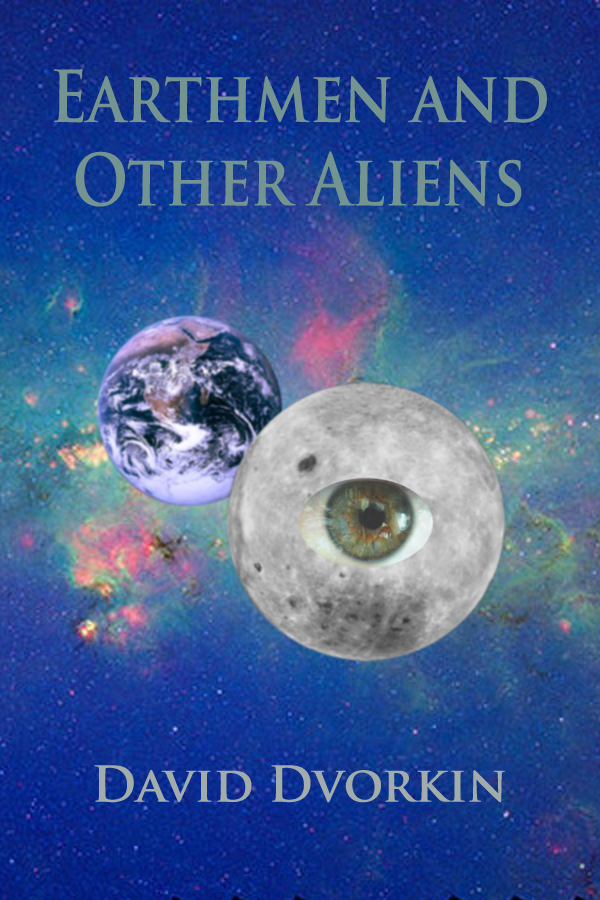
On Amazon (Kindle) and Smashwords (various formats). Barnes & Noble, Sony, Apple, etc. should follow during the coming weeks, as Smashwords distributes to them. I’ve also submitted a PDF version to Google for their e-book store. That’s my first attempt at getting a book included there. If that one’s okay, I’ll start putting all of my others on Google, as well.

Links for ordering, the cover image, and a bit of info:

http://www.dvorkin.com/earthoal/

Monday, December 27, 2010

The Story of the Very, Very Earnest Black Swan

Black Swan is a very, very earnest movie about a very, very good but very, very mentally messed-up ballerina, played very, very earnestly by the usually very, very good Natalie Portman, who unfortunately isn’t quite on her toes for this one.

Portman’s character is given a chance at a career-making role, dancing both the white (very, very good) swan and the black (very, very bad) swan in an odd-sounding version of Swan Lake created by an egomaniacal choreographer (is that redundant?). Who is also very, very sleazy. And slimy.

However, she’s very, very repressed, so while she can dance the white swan with technical proficiency, she can’t let her inner black swan come out and be all evil and seductive on the stage. She also has to contend with a very, very domineering mother (well and creepily played by Barbara Hershey) and a very, very (very, very, very) hot rival (well and deliciously played by the very, very (very, very, very) hot Mila Kunis).

The rival has black wings tattooed on her back. Look! A symbol!

Portman’s character is a sick puppy. She has bizarre hallucinations, can’t separate dreams and fantasies from reality, scratches herself till she bleeds, and thinks there’s a real black swan inside her that, from time to time, comes out – e.g., black feathers poking out through the deep scratches she has inflicted on herself, her neck lengthening into a swan’s neck, black wings growing from her back. She wants to destroy the black swan inside her. She wants to liberate and become the black swan inside her. Everything ends messily.

This is psychodrama as filmed by very, very earnest young film students. The movie works so hard at being arty that it fails at being art. Or entertaining.

There is a fair amount of dancing. Unfortunately, it’s almost all scenes of Portman dancing. She’s a fine actress but only an amateur dancer.

There’s a lesbian sex scene, less than convincing, as is usual in movies, but elevated to hotness because Mila Kunis is in it. (Kunis has one of the few good lines in the movie, and she delivers it with verve.)

Don’t waste your time. If you want to see an entertaining dance movie, rent the delightful movie Center Stage, which starred actual professional dancers who turned out to be excellent actors. I think I need to watch that one again to wash away the black taste of swan crap.

Tuesday, December 07, 2010

Shrieking Zanies on My Screen

Shrieking zanies on my screen
Make this viewer want to scream,
Make this viewer want some booze.
Endless sports on the nightly news.

How they obsess over injuries.
Mangled elbows, damaged knees,
A ruined back or a shattered hip.
“These could cost us the championship!”

Other news is second rate
When compared to our team’s fate.
Wars and floods and all the rest
Matter not if our team’s best.

Skip the news. The weather, too.
Our team’s coach said something new!
Something stupid, something dumb.
There are no depths he cannot plumb.

Shrieking zanies want to claim
Insight into next week’s game.
Coach’s tactics, players plans,
Braindead mouthings from the fans.

I don’t learn the vital stuff.
Will the drive to work be tough?
Will the roads be wet or icy,
And the drive home tense and dicey?

Did the Dow Jones take a dive?
Is democracy still alive?
Has the Middle East exploded?
Have our rights still more eroded?

Might as well just change the name.
“Mindless babble about every game
“Every night on every station
“And that’s it for information!”

Sure, a title that is snappy
Makes a TV exec happy.
In any case, the fact remains:
Sportscast zombies want your brains.

Oh, if I were but in charge
The solid news I would enlarge
The sports “reporters” quickly fire
And proper journalists I’d hire.

No pretty faces mouthing fluff
Smirking at you, all that guff,
Endless babble, wasting time,
While repeating right-wing slime.

They’d all have brains and be well read,
With politics from pink to red.
They’d read the news and analyze.
They’d be Democracy’s prying eyes.

They’d tell the truth and pay no heed
To plutocrats and all their greed,
Their lawyers and their paid-for tools,
Their Limbaugh pigs and Coulter ghouls.

We’d know what’s what,
Who sold, who’s bought,
What deals were made,
What rights in trade.

All that would show
Upon your screen
In this sweet world
Of might-have-been.

But cash controls the info flows
And plutocrats know what to ban.
Once tumbrels rolled. Aristo knows
The danger of the thinking man.

And so they hire pretty critters
A stupid hunk, a vapid fox,
Who, sitting on their well-toned sitters,
Grin vainly from the idiot box.

Their voices loud, of dumbness proud,
They flirt and smirk and pose and preen.
And we are left of news bereft
With shrieking zanies on the screen.

Tuesday, November 23, 2010

Age, relative and absolute

By which I don’t mean “you’re as young as you feel” but rather how one perceives the ages of other people.

When I was somewhere around ten or eleven, I attended some sort of social gathering with people of all ages – most likely some Jewish community event. There was a group of young people there, all in their early twenties, gathered in a group and speaking in their secret generational language and flirting with each other.

I watched them in awe. They were so smooth, so sophisticated, so glamorous, so self-possessed, so in control of themselves and the world. I couldn’t wait to be in my early twenties so that I could be as smooth, etc. as they were!

I’m 67 and I’m still waiting, but never mind that. Now, of course, when I look at young people in their early twenties, I see just barely no longer kids, often trying awkwardly to be smooth, etc. It’s possible that young people in their early twenties now are dramatically different from young people in their early twenties 55+ years ago, but it’s much more likely that the change is in me.

We’ve all experienced this. Throughout most of our lives, “young” is anyone more than a few years, say 5 years, younger than ourselves, and “old” is anyone more than a similar number of years older than ourselves. Look at the photos in your high-school yearbook (You kids today do still have those, don’t you? Why, when I was a lad … ) and you’re astonished at how young and immature those kids look. You don’t remember them that way at all!

Nothing new there. But here’s the thing that’s changed for me. I don’t know when this happened, fairly recently I think, but lately that relative perception of age has given way to a more absolute one. The young aren’t getting younger as I grow older. They’re staying about the same. And “old” doesn’t mean X years older than me. “Old” is a category I’ve moved into myself. Or, on my more denial-of-reality days, am just about to start moving into myself.

I used to be aware of old people referring to themselves and their peers as old people, but that never struck me as odd because to me they were all old people. Now that I’m one myself, officially a senior citizen (What a silly phrase! What if I’d never become naturalized? Would I be a senior resident alien?), I’m speaking the same way.

It seems natural. Although when I think about it, it also seems strange, a bit unsettling.

Rather suddenly, people no longer occupy various positions along a spectrum from very young to very old, with “normal” referring to a narrow band of about 10 years width in the middle of which is yours truly. Now the world is divided into the young and the old, and I know quite well which of those two I’m in.

Sunday, November 14, 2010

Earthmen and Other Aliens

Years ago, an editor suggested that I put together a collection of my short stories. I thought it would be a rather skimpy collection, so I put the idea on hold.

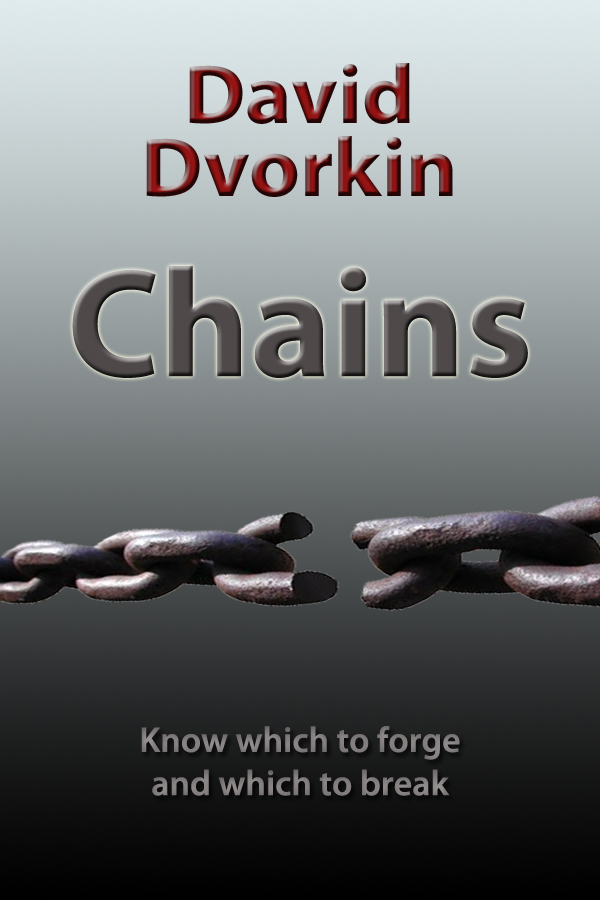
This weekend, I decided to take a break from putting off writing Chains and see what stories I have. There are a few that have been published and a few more that should have been published. So, given that I’ve already leaped into the brave, new, revolutionary, world-changing environment of self-published e-books, which means that there’s no agent or editor to dump me if my sales numbers are disappointing, I’ve started putting together a short-story collection.

The title is Earthmen and Other Aliens, which is (almost) a line in one of the stories. I had originally thought to title it The Eye at the Back of the Moon, the title of one of the stories. I decided against that, but it did give me a cover idea.

It’s taking time because some of the stories were written on a (gasp!) manual (gasp!) typewriter and now have to be scanned in, and then the scanner’s OCR output has to be corrected. In the case of my first published story, I don’t even have a clean typed copy, only photocopied pages from the magazine. The scanner has been having a fun time making up words to match the marks on those faded pages.

There’s also one story I’ve been wanting to write for a while. I was waiting for a suitable market to appear, so that I could write the story, submit it, be rejected, and feel sorry for myself. I can skip some of those steps and just write the story. Which of course is the way it should work, aahtistically speaking. But that will take some time.

I hope to have the book up on Smashwords and Amazon in a week or two Or three. At most. I hope. Other outlets (B&N, Apple, Sony, etc.) will then follow as Smashwords distributes to them.

And I have a cover for it already:

http://www.dvorkin.com/earthoal/EarthmenOtherAliensCover.jpg

Tuesday, November 09, 2010

David Dvorkin, cover designer

I created a page to show all of the covers I’ve created for my e-books, my wife’s e-books, and a friend’s e-books.

Zowie! They look even spiffier when they’re all together like that.

Sunday, October 31, 2010

The Liberated Writer

Four years ago, I started this blog with a post explaining why I chose the name A Blister to My Eye. I said the function of the blog would be to pressure me to complete the time-travel novel, Time and the Soldier, that I had been fiddling with for ten years.

This evening, Leonore reread that original post and suggested that I post something about what’s happened with that novel and with my attitude toward my writing career.

I finished the novel a while ago. Two years ago, I think. All excited, and convinced that it was the book that would revive my professional writing career, I set about querying agents. I got an agent, a big name with a very big agency. He loved the book and sent it out to a number of editors. There were some rejections and a lot of non-decisions. And then he decided to leave the agenting business and become an editor at a major publishing house.

Realistically, that meant that Time and the Soldier was dead. Reputable agents aren’t interested in representing a book that has already been rejected by some of the editors they would want to send it to. The editors who hadn’t made a decision would be possibilities, but still the pool of possible editors would be too reduced.

So I stewed for a while and felt (very, very, very) sorry for myself for a while. Then I got fitfully to work on the next novel, Chains. I’d finish that, use it to get an agent, and then ask my new agent to rep Time and the Soldier as well. My professional writing career would be revived! Woo hoo!

I worked fitfully on Chains, hampered by self-pity, which was in turn increased by my being laid off in May 2009 and by my realization that there were no jobs to be had and I might never have a dependable pay check again.

While I was laid off, I spent some of my time reissuing my and Leonore’s previously published books as e-books. I found that I really enjoyed designing the covers for them. I had thought that would be a chore because I’ve never had an artistic eye or an eye for design, but thanks to Gimp and then Photoshop, I discovered that I did.

Well, that was fine for the old books, which would otherwise be unseen by the human eye. But Time and the Soldier was a new book and deserved real publication – i.e., a print edition, from a major publisher, that would show up in bookstores and on racks in supermarkets everywhere.

And then, quite recently, I realized that my attitude had changed. I was going to write, in this post, about how that evolution in my attitude happened, but the truth is that I don’t really know quite how it came about. After depression, and then anger, I suddenly came to feel detached from the industry at whose doors I had been hammering for decades.

For a brief time, early in my career, in the 1970s and early 1980s, those doors seemed to have opened for me. I seemed to be inside the room, albeit still standing near the door and looking at the happy crowd at the buffet table near the opposite wall. But some invisible barrier still blocked my way, and then a sinister and ineluctable force reopened the doors behind me and pushed me back out and locked the doors in my face. I.e., my career tanked.

So I was back to hammering at the doors, but the sound of my knocking couldn’t be heard within because of the loud voices of the happy crowd at the buffet table. Extend that metaphor if you really want to.

And then I stopped hammering.

Some time during the last year, the publishing industry became an alien thing to me, a noisy undertaking over there, a crowd of people standing in a field, waving their hands and shouting at each other and pushing and shoving, filled with desperation, trampling each other underfoot. Irrelevant, pointless, foolish, distasteful.

So I published Time and the Soldier as an e-book. I was pleased by my own lack of regret. The book that, for so many years, I had thought of as my ticket back into that room and maybe all the way to the buffet table would now float out there in the ether and be read by … a few dozen people, with luck. I liked that idea!

Then I realized that I was thinking of Chains not as the book that would be ubiquitous in a print edition and would revive my professional writing career but instead as my next e-book. It, too, would be read by a few dozen people if I was lucky. But what mattered was that my change in attitude about publishing changed my attitude toward how I was writing Chains.

I’m writing it exactly the way I want to write it. It may end up being very long. Or not. It will have a lot of dialog about many different subjects not related to the main plot. It will be discursive and recursive. It will have many points of view and will jump about between them. It will have characters ranting about this and that – political, social, and literary rants that will of course reflect my own attitudes. I’m already enjoying writing Chains more than I’ve enjoyed writing a book in a long time. It’s a wonderful feeling of artistic liberation.

I’ve already created the cover for Chains, and it’s pretty damned zowie, if I do say so myself, and I do. There’ll be other books after Chains, all of them with zowie covers. There’ll be a collection of short stories, a horror novel, a fantasy novel, and, and, and ...

I’m a writer again! And it feels great.

Thursday, October 21, 2010

The perfect job!

I just got this in e-mail. Name of supposed sender has been replaced by XXX just in case it’s a real person.

Who could resist this offer?

For ,

I'm XXX. I am personnel managr of our Company.
Our department noticed your CV on Jo.b site ,
Our department sure u're fit for the position
of Financial manager.

For more info concerning available j.ob.


This may be the perfect complement to your current
jo.b.

If u're want to start, contact me for the next step
of the process.

With respect

Tuesday, October 19, 2010

Time and the Soldier e-book

Did I not post about this here? Apparently not. What a shocking oversight!

After much sturm und drang and up and down and elation and depression and … you get the picture. After months and years of all of that, I came to a writing-career decision that, for me, was very, very major. Namely, no more with the agents and editors and publishing companies. Embrace the e-book revolution, I told myself. So I published Time and the Soldier as an e-book, putting aside all thoughts of seeing it published physically, let alone seeing it on the racks in the local supermarket.

Which is also to say, I self-published it. Better than having it gather virtual dust on my hard drive, unread by anyone else. It may only be read by a few other people, but that’s still a few more than would read it if it never left my PC. And it will be around and available for purchase forever, or at least for a very long time.

And it has a very spiffy cover, which I created myself via the magic of Photoshop.

Details, including links to buy it in Kindle and various other formats, here: http://www.dvorkin.com/timsol

Too bad I’m not a famous blogger. The book would be virtually flying off the virtual shelves within seconds after I post this.

Monday, October 04, 2010

How We Became Breast Cancer Thrivers

This is a new free ebook. It’s a collection of essays by breast cancer survivors who have a positive attitude about their experience with the disease. Leonore is one of the contributors; her piece is on pages 73-70.

The book was edited by Beverly Vote, who publishes The Breast Cancer Wellness Magazine. You can read about the book on our Web site or on the magazine’s site. If you go to the magazine’s site, click on the link titled “Download E-Book” in small print to the right of the cover image. That opens the PDF version of the book, which is much easier to read than the digital version that the “View Now” link takes you to.

Monday, September 27, 2010

Sniffle, sniffle

I just saw the following announcement of a short story sale. Names disguised to protect them. And possibly me.

Xxx has a narrative poem, “xxx,” in Xxxxx, an anthology of stories around why women are blamed for everything. The book is edited by Xxx and available on Amazon and other venues.

Monday, August 30, 2010

As We Know It

“If we don’t act now, civilization, AS WE KNOW IT, will be destroyed.”

“If we don’t stop this asteroid, it will mean the end of LIFE AS WE KNOW IT"!”

But civilization/life as we don’t know it will be fine?

I really hate that kind of meaningless, reflexive verbiage. It gets added to proclamations, I think because the speaker has heard it so often that he thinks it’s necessary, even though it adds nothing to his statement. Or else because he’s a kneejerk twit.

There are other examples. After Nixon used the phrase “at this point in time”, perhaps during the Watergate crisis, everyone started saying “at this point in time” when they meant “now". Now, damn it, now!

Nixon was the first person I heard say, “I misspoke myself,” instead of, “I was mistaken,” or “I am a pile-of-shit, amoral, soulless, lying crook.” After that, other speakers started using that phrase. Which is okay if you’re a pile-of-shit, amoral, soulless, lying crook. If not, you should probably avoid it and just say something like, “Sorry, I spoke carelessly.”

The first person I heard say “with all due respect” was Jimmy Carter. It was during one of the presidential debates, either in 1976 when he was debating the silly but not evil Gerald Ford or in 1980 when he was debating the Good-God-what-an-evil-pile-of-stupid-shit Ronald Reagan. If I weren’t so old and if I hadn’t drunk so much bourbon, perhaps I’d remember which it was. Not that it matters. Silly but not evil on one hand. Evil pile of stupid shit on the other. Or Republican presidential nominee, for brevity’s sake.

(I think it was 1976, and I think it was in response to Ford clumsily misspeaking himself at that point in time about how East Germans or Poles saw themselves in relation to the Soviet Union. As we knew it.)

I remember being astonished at Carter’s using that phrase. Respect? I thought. For that gray space on the podium? Are you kidding? What respect could you, a highly intelligent, technically educated, well spoken man possibly have for that creature? Why did Carter say it? Was he trying, kindly, to soften the blow before demonstrating how brain dead the Republican was?

Why bother? If you don’t respect the other guy’s opinion, don’t bother with the empty phrase “with all due respect”. If you’re predicting the end of the world, then predict it; don’t add excess words like “as we know it”. If you’re a Democratic candidate debating your opponent, just say, “You’re an astonishingly stupid pile of evil shit, and the policies you propose would destroy civilization. You need to be shut away in a loony bin right now. Jerk.”

Sunday, August 22, 2010

David’s Definitions for October 2010

Bromidic

An adjective describing platitudes, trite sayings, clichés. A person who constantly utters such stuff can also be called bromidic. This describes a lot of politicians and speakers at graduations. In the great musical "South Pacific," Nellie Forbush describes herself as bromidic - boring, ordinary, and "a cliché coming true." The adjective bromidic comes from the noun bromide, which refers to such platitudes and clichés. A person who tends to utter bromides can also be called a bromide. In turn, bromide comes from chemistry. Yes, chemistry! Not because chemistry is a cliche, but because a bromide is a compound of the element bromine and some other element, and 100 years ago, certain bromides, in particular potassium bromide, also called bromide of potassium, were commonly used as sedatives. Hence bromide came to mean something that puts you to sleep - like the typical graduation speech. Interestingly, the element bromine, where all of this started, has a very pungent smell, and the name bromine comes from a Greek word that refers to the stench of billy goats, which is not something that any of us would consider bromidic.

(Will be published in the October 2010 issue of Denver's Community News.)

The Scrabble word score of bromidic is 15.
You can find that out here:
http://www.dvorkin.com/scrabscor.html

I'm collecting all of these at:
http://www.dvorkin.com/davidsdefs.html

Fascinating Word Facts

Did you know that:

The words "race car" spelled backwards still spell "race car"?

"Eat" is the only word that, if you take the first letter and move it to the last, spells its past tense, "ate."

And if you rearrange the letters in "Tea Party Republicans," and add just a few more letters, it spells: "Shut the fuck up, you free-loading, progress-blocking, benefit-grabbing, resource-sucking, violent, hypocritical douche bags, and deal with the fact that you nearly wrecked the country under Bush and that our President is black, so get used to it."

Isn't that interesting?

Thursday, July 22, 2010

David’s Definitions for September 2010

Senile

Nowadays, we use this word to mean old and infirm, weak from old age. This usage dates from the mid-19th century. Originally, the word just meant having to do with old age. It comes from a Latin word meaning old. Other words that derive from the same Latin root are senior, senescent (growing old, characteristic of being old), and the Spanish title señor. The medieval English word seneschal, a senior servant, comes from the same root combined with a Germanic word, skalk, for servant. I haven't been able to find out if skalk has any connection to our word skulk, which can mean to evade work. Presumably, one of the duties of the seneschal was to make sure that the lower-level servants didn't skulk.

(Will be published in the September 2010 issue of Denver's Community News.)


The Scrabble word score of senile is 6.
You can find that out here:
http://www.dvorkin.com/scrabscor.html

I'm collecting all of these at:
http://www.dvorkin.com/davidsdefs.html

Tuesday, June 22, 2010

David’s Definitions for August 2010

Risible

Laughable, but in a negative sense. You wouldn't call a comedian's jokes risible if you liked them. If he was a painfully bad comedian, you could say that his attempt at comedy was risible. This is not a common word in modern English. It usually only shows up in pompously written book or movie reviews or political essays - the sort of thing written by people who can't see that their stuffy prose isn't admirable but is instead risible. The word appeared in English in the 1500s. Back then, it meant able to laugh, capable of laughing. By the 1700s, it had come to mean evoking laughter, laughable, but it didn't have a negative connotation yet. That's more modern. The root is the Latin word ridere, to laugh. Our word "deride" comes from the Latin combination de (down) combined with ridere. Someone who uses "risible" in ordinary speech is likely to encounter derision.

(Will be published in the August 2010 issue of Denver's Community News.)

I'm collecting all of these at:
http://www.dvorkin.com/davidsdefs.html

Saturday, June 19, 2010

But doctors urge caution blah blah alcohol blah blah

Last night, TV news carried yet another story about the benefits of alcohol. This one concerned the new Dutch report of a correlation between moderate alcohol consumption and reduced risk of several types of arthritis.

After the teaser for that news item, I said to Leonore, “I bet they’ll quote doctors warning people solemnly about the dangers of alcohol.” Of course I was right. Doctors caution against blah blah blah. Because of course if they didn’t give us those warnings, we’d all rush out and drink ourselves into the gutter and divorce and bank robbery and liver failure.

I’ve seen articles about the benefits of tea and coffee, and those lacked solemn warnings against taking up tea and coffee drinking. Yet historically tea and coffee houses have led to far more revolution than alcohol ever did. Possibly to more social unrest and planning of bank robberies, too, but I lack solid data regarding those.

Only when it concerns alcohol does the medical establishment – or maybe it’s the medical journalism establishment – feel the need to moralize, the conviction that without their stewardship we’d all go to Hell. Twits.

Sunday, June 13, 2010

Great review of Dawn Crescent

The book was published a few years ago, but this review seems to have just shown up on the Joe Bob Briggs Web site.

I’ve just reissued the book as an e-book via Smashwords, so I hope this will do some good.

Tuesday, June 08, 2010

Forgive my indignation

Latest version of the Nigerian scam came in e-mail today:

Compliments of the season

Forgive my indignation if this message comes to you as a surprise and may offend your personality for contacting you without your prior consent and writing through this channel. When I was searching for a foreign reliable partner I assured of your capability and reliability to champion this business opportunity. I Request you to partner with me in order to finish a transaction worth 18,500.000.00 USD and transfer from here to your country. Your share would be 30% of the mentioned amount above. If you are interested, then reply me with your Full Names,Address,Age,Occupation,Phone,fax/nofor instructions :

Monday, June 07, 2010

Interview version of the school dream

I have a phone interview scheduled for this afternoon. Last night, I dreamed that I had decided to call it off. No idea why; it’s one of those things that make sense inside the dream.

Because Leonore and I were planning to go for a walk, and because the company was located near our house (in the dream, not in the real world), I said let’s just walk over there and I’ll cancel the interview and not bother calling or e-mailing to do it. We left the house with me wearing jeans, a t-shirt, and flip-flops with white socks. Yes, the socks made that uncomfortable. Leonore said, “Maybe you should wear business clothes, just in case someone there wants to talk to you.” I said, “Nah, I’ll just tell the receptionist.”

The actual company is small and headquartered here. The dream version was a minor branch of an international giant. Fancy waiting room full of suited people filling out application forms. I identified myself to the receptionist, who immediately pulled out a bunch of forms for me to fill in and said that as long as I was there, they’d just do the interview in person.

Cowed, I said nothing, went to a seat between two men in suits and ties, and started filling out the application form. Leonore was right, I thought. I should have worn business clothes.

It was really cold in there, too.

And then the dream ended. I bet I got an F in the course.

Saturday, May 22, 2010

David’s Definitions for July 2010

Effect, Affect

A reader asked me to define these two words and explain how to use them. They're closely related words, very similarly spelled and pronounced, so it's easy to see why people get them confused. Affect is the verb, the action word. "The tragic story affected him deeply." Effect is the result. It's the noun, the thing. "The tragic story had a powerful effect on him." Perhaps it would help to think of the word effective. Something is effective if it has an effect. Unfortunately, and to make things more confusing, there are a couple of cases where the situation is reversed.  Effect does have one use as a verb: to bring something about, to cause something to happen. "The prisoner effected his escape by jumping from the police car." And affect has one use as a noun, meaning one's mental state. Fortunately, both of these uses are rare in ordinary English. Affect can also be used as a verb in the sense of "pretend": "He affected an air of cynicism." I think that use is rather old fashioned, though. I hope the effect of all of this is to leave you less confused, rather than more.

(Will be published in the July 2010 issue of Denver's Community News.)

I'm collecting all of these at:
http://www.dvorkin.com/davidsdefs.html

Tuesday, May 18, 2010

Vile

I think vile is becoming one of my favorite words.

It so perfectly describes the moral foundation of certain movies – e.g., The English Patient, Like Water for Chocolate – and political movements like the Tea Bagger idiots and the contemporary Republican Party.

Then there are the Promise Keepers and the Dominionists. Vile.

The National Rifle Association. Vile.

Free Republic. Vile.

No doubt the list could be a lot longer.

And of course the word is an anagram for evil. Coincidence? Yeah, right.

Saturday, May 01, 2010

Second Smashwords book

Business Secrets from the Stars, which is currently available in trade paperback and hardcover from Norilana Press, but not in e-book form. I’ve put it up on SW:

https://www.smashwords.com/books/view/14043

I’m really pleased with the cover I created. Click on the image for a big version.