Monday, March 19, 2012

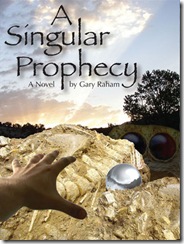
A Singular Prophecy

A Singular Prophecy
Gary Raham
Biostration, 2012

singularprophecy

70 million years ago, an alien race, fleeing the destruction of their world, landed on Earth. Here they would recreate the world they had lost. Unfortunately for them, Late Cretaceous Earth was a fiendishly hostile place, and it destroyed them. That is, it destroyed their bodies. Before they died, they used their technology to preserve their personalities in anticipation of the evolution of a more hospitable environment.

In our own time, a young paleontologist on a dig pries a sphere from the midst of fossil dinosaur bones and suddenly finds himself the host of one of those personalities. As they struggle to coexist in one body, the paleontologist and his not–so–welcome guest learn that the alien personality is not the only one to have reawakened. Moreover, the conversion of part of the earth into a recreation of the alien world that was lost so long ago is well under way.

A tale of alien possession and deep time becomes a moral struggle for both human and alien. The latter, especially, is forced to question its fundamental beliefs about the superiority of its kind and its presumed right to take over a world already inhabited by beings the alien finally recognizes as morally and intellectually on a par with itself.

The alien worldbuilding, told through flashbacks and the memories of the alien refugees, is simultaneously dreamlike and convincing. The biology of the aliens, and in particular their imaginative lifecycle, is shown to us mostly through their eyes, giving it a welcome solidity and realism. Too often in sf novels, such details struggle to rise above the level of intellectual exercise. One stage in the life cycle, the ambuli, we first see through the aliens’ memories. Later in the novel, we suddenly see ambuli through the eyes of humans, and instantaneously the ambuli become terrifying and very alien predators. Raham uses this technique of a double view of things very effectively.

For more information about Raham and his work and writing, see his Web site. To buy A Singular Prophecy, click on the image of the cover, above.

Tuesday, February 21, 2012

The Arm and Flanagan

My latest fiction publication. I'm putting it out as an e-book on Amazon, etc.

It's a novella or a very long story, or something like that. A mixture of suspense and sf, and hopefully Twilight Zoneish. It's just over 13,000 words. Publishing fiction of this length is something new for me. You can't charge less than 99 cents on Amazon, and I have no idea how people feel about paying a dollar for something of that length.

So far, The Arm and Flanagan is available in Kindle format on Amazon (http://www.amazon.com/dp/B007BQDG48), and also on Smashwords in various formats. It will be showing up in the other online stores over the next few weeks.

http://www.dvorkin.com/armflan/index.html

Monday, January 09, 2012

Red Riding Hood

I just watched part of the recent movie "Red Riding Hood" on TV.

I had no idea that all the girls in a typical medieval village were so hot. And had such nice teeth. The young male leads were also quite pretty, and it's even possible that some of them are heterosexual. It was a flop in the theaters, I believe; it should have been a CW series.

Gary Oldman chewed the scenery as a strange (of course!) priest. At one point, when looking for a witch among the villagers, he says that one of the signs to look for is a person exhibiting strange odors. Oh, Father. It's the Middle Ages.

Wednesday, December 21, 2011

Regressive Voice

Some years ago, I put an essay on my Web site titled Progressive Voice. It was a call for progressives to speak up and counteract the shrill volume of the right wing. I also said that progressives are the real Americans, and we have to make that clear to the country.

I’ve had the occasional supportive e-mail in response. Today I got one from the other side. It demonstrates just how dangerous the right wing really is:

David,

I glanced over your manifesto with complete shock.

Al I can say is Are you fucking kidding me?. You and any that think the way you do MUST be hunted down and permanently removed from Society.

Progressives are a cancer that has infected our great nation and MUST be eradicated.  YOU are the Enemy, YOU are the traitors YOU MUST be eliminated.

Sunday, December 11, 2011

Dust Net

Governments want to control access to the Internet in order to remain in power. Corporations want to control access to the Internet in order to make lots of money. Both of them can maintain such control only as long as citizens/consumers are forced to access the Internet through a relatively few bottlenecks. Those are the points where government can choke off access; those are the gateways for the use of which corporations can charge exorbitant fees.

Political activists in countries with repressive governments have devised ways ― e.g., dialup access to proxy servers― to bypass government barriers to Internet access. Direct communication with satellites is another possibility; this is already popular in some countries as a way to watch television programs the government disapproves of. However, for the foreseeable future, communications satellites will be under the control of governments and giant corporations, so they aren’t a reliable and untrammeled avenue to the Internet. Proxy servers depend on the existing Internet backbone, which merely moves the possibility of government/corporate control one step further away from the person trying to get online.

Technological evolution will continue to provide new ways to evade this control, and governments and corporations will continue to evolve ways to block each new avenue of evasion. But two particular evolutionary trends are coming that will change this warfare between offense and defense in a fundamental way. They will change society, too, in profound and disturbing ways.

The first evolutionary trend is the increasing miniaturization and power of Internet–connected video and sound recording devices. They’ll soon be undetectable. Police won’t be able to arrest people for recording them in the act of, say, abusing peaceful protestors because the police won’t know which bystander is recording them and instantaneously uploading the video to YouTube. The increasing availability of WiFi hotspots and Internet access via the cell phone network also means that there are ever fewer physical locations where such abuse can take place without recordings being made and uploaded.

Except, of course, inside police stations or secret CIA torture camps. But hold that thought.

The second evolutionary trend is the shrinking of computers.

Some day, nanocomputers will be part of the nanotechnology tidal wave that will overwhelm us with technology indistinguishable from magic. The world will change. Human beings will change. But we don’t have to look that far ahead to glimpse the sea change I’m talking about.

Perhaps the efforts to create quantum computers will succeed, bringing us immensely powerful computers smaller than a human cell. But even if that technology never does come to fruition, powerful small computers are inevitable. Maybe they won’t be smaller than a human cell. Maybe they’ll be as big as a human cell, or as big as a speck of dust. That’s small enough to do the job I have in mind.

Major steps have already been made in that direction. The US military, as well as a consortium of universities, has been working for at least ten years to develop smart dust ― clouds of microscopic machines, wirelessly connected to each other, able to perform military tasks, espionage, exploration, and rescue. The last two sound wonderful, but no doubt far more money and brainpower are being poured into the first two.

In any case, microscopic networked intelligent machines will soon exist. Then, smart dust will quickly evolve from networked microscopic sensors with some computing power into powerful, microscopic networked computers.

Within a few years ― ten at the most, but probably no more than five ― invisible clouds of such computers will be drifting in the winds and floating on the seas. They will be present almost everywhere in the world. They might be powered by sunlight, or the energy of wind or waves, or changes in barometric pressure, or they might draw all the power they need from the manmade microwave energy bathing all of us all the time. Many of them will be military devices, gathering intelligence, keeping watch on other countries and on citizens. Many will be corporate machines, gathering information designed to make very wealthy people even wealthier. These machines won’t need the Internet. They will form their own networks. Since I’ve described two categories of machines, let’s call their two networks Gov Net and Plutocrat Net.

Increasingly, mixed among these clouds of drifting, floating dust–speck computers will be others produced by small groups of individuals with no connection to government or to the corporatocracy. Technology, especially electronic technology, behaves that way. Neither the government nor big corporations can keep control of it for long.

This third class of dust–speck computers will constitute a third world–wide network far greater than today’s Internet. Let’s call it Dust Net. Its purpose won’t be repression or profit but access to data, opinion, and like–minded human beings.

At this point ― let’s say five to ten years from now ― all those who have smart phones or other WiFi–equipped devices, almost anywhere in the world, will have complete access to Dust Net. Their governments won’t be able to block them, and corporations won’t be able to charge them. Dust Net will be an immensely powerful force for freedom.

But something else will be happening at the same time.

Let’s return to the evolution of tiny recording devices. I believe that that technology will be integrated into the microscopic servers making up Dust Net and its government and corporate equivalents. Smart dust was intended for data collection from the start, so copious data storage capacity is inherent in the design of the machines. Dust Net will become an infinitely distributed, infinitely replicated, infinitely accessible database containing full sound and video recording of everything that happens everywhere on Earth.

Of course, the same will apply to Gov Net and Plutocrat Net. They’ll be watching, recording, and storing everything, too.

No place in normal life is truly dust free. It’s frightening to think that every moment of your life will be recorded, stored away, and accessible to anyone who cares to view the recording. We’ll be living in a global village where not only do none of the windows have blinds but all the walls are made of glass.

Fortunately, we’ll have Dust Net. While governments and corporations watch us, we’ll be watching them. There won’t be any more secret meetings in Washington, DC or anywhere else. Like it or not ― and they won’t ― plans by governments and corporations to control us and limit our freedoms will be out in the open and known to all of us ahead of time. All governments and all boardrooms will be truly and completely transparent.

They’ll try to fight Dust Net with dust–free rooms. But even if they go into those rooms naked, they’ll bring the motes of Dust Net in with them ― inside their ears, their noses, their lungs. They’ll try to destroy Dust Net by hardware or software methods. The immense redundancy and constant checking and comparing of data between dust motes should defeat both approaches.

Premeditated crimes will largely disappear. Spur–of–the–moment crime will be virtually certain to be punished. Graft, corruption, and collusion will largely disappear. So will the very concept of privacy. And all this is coming whether we like it or not.

“What are you doing here?”

This is a small thing, but it bugs me. It seems to be new, and the buggishness factor grows each time I hear it.

In TV shows, when Character A is surprised at encountering Character B doing something unexpected, A will say, “What are you doing here?”

So far, so good.

Much more commonly, the situation is that A unexpectedly encounters B in a place where B should not be. A should say, “What are you doing here?” Instead, A always says “What are you doing here?” Same emphasis as in the first situation, but completely inappropriate in the second.

It’s as if TV actors and/or directors only know one way to say that sentence, no matter what the situation is in the story. If only they’d spend some time thinking about such details instead of mindlessly churning out product, the world would be a slightly brighter place. And I’d be somewhat less bugged.

Yeah, I know. The economy is struggling to avoid a double dip, a band of Republican wackadoodles is slavering to be president and so dense is the American voter that Obama is not crushing them all in the polls by a margin of 99 to 1, the Middle East (that’s what I’ll always call it!) is bubbling even more than it usually does, climate change is upon us and accelerating even while those same wackadoodles deny its existence, etc., and I’m complaining about television actors placing the stress on the wrong word.

But that’s an argument against all blog posts that aren’t dreadfully serious and deep and penetrating and that don’t contribute to solving the world’s problems. Fret not. My next post is going to be long, dull, terribly serious, and it will radically change human society. I should be working on it now. I shouldn’t be here. What am I doing here?

Thursday, November 24, 2011

Obligatory Thanksgiving Day Thankfulness Post

Okay, I'll join the crowd and say what I'm thankful for. More to the point, since I’m an atheist and therefore don’t believe in a supreme being or other divine or supernatural force, I’ll say whom I’m thankful to.

I'm thankful to Leonore for my wonderful marriage and daily happiness. I'm thankful to a bunch of 17th and 18th century political philosophers for the system we live under. I'm thankful to Franklin Roosevelt and Lyndon Johnson for Social Security and Medicare. I'm relieved, rather than thankful, that the tides of politics have kept the Republican Party, that well of vileness, from destroying those two programs. So far.

Tuesday, November 15, 2011

Look. Up in the tree. It’s your brother-in-law.

I was collecting fallen, rotting apples from around our apple tree yesterday. It produces a lot, these days, so there are lots of them left on the ground, and they stink after they've been lying there for a few days. Many of them have been nibbled on, presumably by the swarms of squirrels and/or rabbits that infest our back yard. Maybe just the squirrels. Rabbits seem to prefer grass and vegetables. I've seen the squirrels holding apples and gnawing on them.

Lazy beasts. We give them free room and board and a big yard with trees, but they don't contribute a thing. You'd think they could at least collect the extra apples. Better yet, eat the whole thing and process it all into lawn fertilizer. It's like having a whole bunch of the world's worst brothers-in-law camped on your couch and drinking your beer and dropping the empties on the floor.

The rabbits all waddle around slowly. At least the squirrels are fun to watch. Slow movements don't seem to be in their DNA.

Thursday, November 03, 2011

Letter to Diana DeGette

Sent today.

Dear Congresswoman DeGette:

We are long–term residents of District One, having lived in Bear Valley since 1971, and we want to express our severe disappointment about your Yea vote on the recent House resolution concerning “In God We Trust” as the motto of the United States.

We can’t understand why you would support the Republican Party’s blatant pandering to ignorance and their continuing cynical, politically motivated misrepresentation of the nature of our country. We urge you to introduce a resolution to return our national motto to the original version, “E Pluribus Unum,” an inclusive and unifying phrase far more in keeping with the secular government the Founders created.

Sincerely,

David and Leonore Dvorkin
www.dvorkin.com
www.leonoredvorkin.com

Monday, October 31, 2011

Another Step Closer to Full Retirement

MileHiCon, our local science–fiction convention, was the weekend before last. The con always leaves me feeling like a real writer (as opposed to a poseur, which is how I tend to feel the rest of the time) and full of enthusiasm for writing. In the past, those positive feelings were tempered by the need to go back to my job on the Monday after the convention ended. Or back to looking desperately for a new job during my periods of being unemployed.

That should have been different during the last two years, a time when I’ve been referring to myself as retired. Except that I wasn’t really retired, not completely.

After I was laid off from Quark in May 2009, I signed up for Social Security as a backup, and I kept looking for a new full–time, permanent job. (Let’s put aside the absurdity of calling modern jobs “permanent”.) In the meantime, I picked up some contract work, both tech writing and Web development. At some point during 2010, I accepted the fact that thanks to the economy and my age, a new full–time, permanent job was extremely unlikely. I also knew, or perhaps admitted to myself, that I really didn’t want one. Instead, I decided that I would keep on looking for contract work, as close to full time as possible.

So, just as I had been doing since being laid off, every day I did the Monster/Dice/Indeed/Craigslist/etc. thing, sending out zillions of resumes, getting some responses by e–mail or phone, going for some interviews –– working almost full time at getting full–time work. I was looking for contracts, but it was no different, in terms of time and psychological investment, from looking for a permanent job. As a result I continued to feel that writing was something temporary, and that time spent doing it was a vacation from reality. On some level, I thought that time spent writing was self–indulgent and self–deception. Nonetheless, just as I did for all those decades–that–felt–like–centuries when I was working full time, I kept daydreaming of the big hit book that would free me from any necessity to work and would convert me into an actual, genuine full–time writer.

I began to burn out on the emotionally draining job search. The return was too small for the investment, which was my life. Bit by bit, I reduced the amount of looking. I dropped some job list Web sites from my search, and I unsubscribed from various e–mail job listings. I also spent some time reissuing my old, previously published novels as e–books. Eventually I self–published my new books the same way. (Naturally, I track the monthly sales of all these e–books in a spreadsheet, with cool line graphs, and I get depressed when the lines dip and elated when they rise.)

I’ve continued to pick up the occasional contract job. Some have been Web development contracts; I do that work at home on my own computer. Others have been technical writing contracts. The writing jobs require spending the working days at the client’s office. Both Leonore and I hate those periods. Of course I worked in offices away from home at a succession of regular, full–time jobs for decades, but the more than two years we’ve spent together, all day and every day –– finally living the life we assumed we’d be living when we got married 43 years ago –– have made us both hate being apart at all now.

No, I don’t mean that we spend our days jammed side by side in a love seat. We have separate studies and separate work. But being together in the house, able to talk to each other whenever we want, able to take long walks together, able to go out to a movie or a restaurant, seems natural. It’s the way we set out to be, and it’s the way the Universe intended the two of us to be.

Except when I go off to do some technical writing somewhere. And except for the times when I’m thinking of the next job away from home or recovering from the effects of the last one. Those effects seem to be worse and to take longer to dissipate each time.

So. Back to MileHiCon.

For various reasons, this year’s con (number 43, the same number of years that Leonore and I have been married) left me feeling even more filled with writerly energy and enthusiasm than in previous years and more optimistic about my writing career than I have for a long time. A flurry of e–book sales, starting on the last day of the con, helped a lot.

Leonore also enjoyed the con and came away feeling more optimistic about our future. On the morning of the last day of the con, October 23, she said something to me that she had been wanting to say for some time. It finally seemed to her to be the right time to say it. She repeated how much she hates having me working away from home, and she said that she really wanted me to no longer accept any contracts other than short ones that I can do by telecommuting. She knew (because she’s always been uncannily able to read my mind) that I had wanted to take this step for a long time but that I would feel guilty if I did so because it would mean turning down the extra income. She told me that rejecting non–telecommuting contracts would not constitute self–indulgence and laziness and selfishness (reading my mind again) because writing is my job, my real job.

I felt suddenly relaxed and calm. Some inner tension I hadn’t realized was there went away immediately. I knew that she was right about taking this step; it was the right step and the right time. This was the right move, an exceptionally good move, and as is usually the case when something exceptionally good happens in my life, I have Leonore to thank for it.

Perhaps you think that I’m making too much of this. After all, I’m not yet talking about full retirement –– or rather, full–time writing –– but simply a step in that direction. But it’s a very major step because it removes the aspect of our situation that was stressing both of us the most before, the periods of separation and the knowledge that more such periods were ahead of us. That’s gone now, completely and permanently.

As for the money -- well, maybe the book I’m working on now will replace that. Or even more than replace it. And if not that book, then maybe the next one. Or the one after that. And so on, from now on.

Wednesday, October 26, 2011

Those Awful Self-Published Books

A couple of weeks ago, on his excellent blog, Nathan Bransford asked the following question: Have You Ever Read a Self-Published Book? In addition to answering the question, he invited his blog readers to say whether they liked the book(s) in question and whether they would read more self-published books.

The responses, in the comments section, ran the gamut and include positive entries from people who have themselves self-published. I didn’t do a count, but I think most of the comments were negative. Some repeated the condescending putdowns that have become standard whenever self-publishing is discussed. Here’s a good example:

I read a self-published novel … once….

It was horrible.

…

When I shop for novels I look inside at the publisher, and if I don't recognize the name, I google it. If the book is self-published, it's a major turnoff.

Sorry, but I think gatekeepers are a good thing.

Gee. I’ve read at least one book published by a major publisher that I thought was horrible. I guess that means they all are.

We all know that major publishers ne-v-v-v-er publish bad books. “Bad” is subjective, of course. The prose in any book lavishly praised by literary critics will make some readers shake their heads and laugh at the abominable quality of the writing. The same is true of any bestselling book scorned by critics, although it’s probably truer for books in the first category than for those in the second. Based on my frequent reaction to books in both categories, I can only say that, in my opinion, well known publishers spew out great quantities of bad-to-abominable books.

In fact, I have read parts of self-published books that I considered very bad. It could well be that if I read a huge number of self-published books, I’d conclude that they are more likely to be bad than are books published by established publishing companies. But that’s because I’ve absorbed the same general standards of literary judgment that editors and most readers have. At base, those standards are simply matters of opinion. They can’t be justified in some objective way. They are not laws of nature, no matter how many people have been educated – trained, brainwashed – into agreeing with them. Moreover, they are transitory. They’ve changed greatly in the past and continue to change. Self-publishing – all those “bad” books – is blowing those subjective standards, those mere matters of opinion, to bits. Protest and condemnation will not stop or even slow this process. This is a tide that no one can stem.

I’ll return to this point in a moment.

What about the physical quality of self-published books? No doubt the appearance, layout, covers, and proofreading of the product turned out by big publishing companies are higher and more consistent than is the case with self-published books. Major publishers are far from flawless, but of course they have more people providing quality control than does a writer publishing his own book, and so their error rate is bound to be lower. If a low error rate is your main criterion when choosing reading material, then you should avoid self-published books. I can’t imagine why this would be anyone’s main criterion when choosing what to read, but there have always been people who prefer presentation to content, appearance to substance.

Okay, but what about covers? Shouldn’t the outside of the book at least be attractive? Look at any large number of self-published books, whether e-books or printed books, and you’ll see a few clumsily designed covers and a lot of beautiful ones. Moreover, you’ll see more imagination and originality than you will with books published by major publishers. Self-publishers may create they own covers or they may hire freelance cover designers to do it for them, but in either case, they’re not bound by the guidelines and limitations enforced by a publishing company’s marketing department.

Let’s return to the issue of editing, of the presumed necessity that a book’s prose be modified by a professional editor so that it conforms to the rules of grammar and spelling. This is done to increase the book’s chances of selling well. Editing is not done for art but for commerce.

Because of financial pressures and cutbacks at publishing houses, there’s less such editing being done now than in the past. Moreover, bestselling authors tend to be edited lightly or not at all. And yet they continue to be bestsellers. Why? Because the public likes their writing styles and the stories they tell, and the public doesn’t care about grammatical lapses. In which regard, those writers are no different from self-published writers who hit it big.

Some of the editing done at major publishers is very good. Some of it is quite awful, as many published authors can attest (especially after a few drinks). Even if it were all good, even if the published version of every book were far, far better than the version submitted by the author, that should bother you as a reader. It should bother you to think that, if honesty and transparency prevailed, the bestselling novel Catchy Title by John Smith would be listed as a collaboration credited mostly to the editors and with John Smith listed at the end of the credits under Story Idea by.

Excellent editors and cover designers aren’t limited to major publishing companies. Self-published authors can hire freelancers to edit their manuscripts and/or create covers for them, and many of them do exactly that – with generally better results, I’m convinced, than if the same work had been done for them behind the wall of a big publisher. Where will you find such editors and cover designers? You could start by looking here.

Don't assume that all self-published books are new books being put out by new and inexperienced writers. In fact, many of them are reissued books, revitalized versions of books that were previously published by mainstream, traditional publishers. The lifespan of traditionally published books is short. In the past, authors got the rights to their old books back and tried to find a small publisher to reissue them, usually without success. Nowadays, authors are turning to self-publishing to reissue those books that were previously languishing in a sort of literary limbo, often available only as used copies, which earn the author nothing. These reissued books can be put out either in e-book or print format, from places such as Smashwords and CreateSpace. Then they can earn the author much higher royalties than before, up to 80% of the cover price. This is especially appealing to authors like me whose careers receded into limbo along with their old books.

This is giving me and other previously published authors a great deal of new hope and energy. But what is at least as important is that the authors can now change the previously published texts to suit themselves, free from the interference and inferior judgment of the editors at the traditional publishing houses, who often took it upon themselves to change things as fundamental as the title that the author wanted. In my own case, I have been able to change the text of several of my books to bring them back in line with what I first wanted but was forced to change prior to publication. Not only is the new version the book I actually wrote, but also it’s superior to the version that was published before by the big publisher. The editing done by the publishing house didn’t improve the book; quite the opposite.

I have also been able to create my own cover designs, a process I much enjoy. You can find my creations thus far here.  

Free of all the old editorial bullying and restrictions, I am now getting the last laugh, as well as almost all of the new revenue from sales. I'm also selling many more books in e-book format than I had been selling in print format for the past several years.

Note, too, that many of the great literary classics of long ago were in effect self-published books, or at least author-edited ones. Who knows how much such works would have been harmed and diminished if today’s inspiration-stifling publishing establishment had been in place back then?

The post on Nathan Bransford’s blog to which this is a response was about self-published books in general, but because of the continuing explosion of self-published e-books, and because the rise of e-books has opened self-publishing to far more people than would have considered that avenue before, I look at his question and the commenters’ answers as really, or mostly, applying to self-published e-books. The e-book revolution, or tsunami, is upon us, and that’s the form of self-publishing that really matters now.

That tsunami will do more than destroy the publishing companies that dominate print publishing. It will change the nature of writing itself, especially fiction. This is the real importance and wonder of the great change now underway. This is also the subject of my own most recent e-book, a very long essay titled The Dead Hand of Mrs. Stifle. Check it out. By which, of course, I mean buy it.
Saturday, June 25, 2011

How to keep summer from getting hot

This morning I put on sandals and shorts from the first, instead of starting with jeans and running shoes and changing later. I'm facing reality: it's gonna be hot.

I realized that every summer, I delay doing this because of a kind of magical thinking -- that if I put on warmer clothing in the morning, that will fend off the heat.

Now you must excuse me. There's a voodoo doll calling for my attention.

Sunday, June 12, 2011

Making money from homeopathy

Thanks to an online discussion about TV ads for homeopathic remedies (a.k.a. “remedies”), a way to make money from the manufacturers of these scams suddenly occurred to me.

Okay, forget the “scam” part. This only applies to those manufacturers who believe that their products actually work – that the theory underlying homeopathy is valid instead of absurd.

It occurred to me that such manufacturers should be willing to pay for commercials that aren’t aired at all.

It’s a bit more complicated than that. The unaired commercials will only work if they are properly prepared. Let’s call this process of preparation the dilution phase.

First, a commercial is scripted and filmed. Then it’s integrated into the TV program in preparation for broadcast. Let’s say that a complete video of the program, including the commercial, is shown on a TV set in the … lab. Let’s call it a lab. This version isn’t aired. Instead, the length of the commercial is cut and the video is shown again. This step is repeated until the length of the commercial is reduced to zero minutes. Clearly, the commercial’s message remains embedded in the TV program by way of its effect on the program’s vibrations – the TV signal. An electromagnetic field has a memory that’s even more powerful than that of water.

As you can see, this is already sounding more scientific and technological than homeopathy.

But that’s just the first step. I can offer something even better. If those manufacturers pay me enough, I will guarantee not to broadcast their commercials at all on the TV station I don’t even own. Clearly this would make the effect of their commercials even more powerful. These ultimately diluted commercials would drive consumers to buy those homeopathic medicines in huge numbers. My fee for pulling off this powerful effect would be only moderately exorbitant.

As an aside, it occurs to me that both the manufacturers and the retail outlets should be able to increase the income from sales of homeopathic remedies even more by stocking the shelves with those medicines and then, a few packages at a time, removing them till there’s no visible sign of them. The vibrations will remain in the shelves’ memory. Surely if water, a fluid, has a memory, then a solid should have an even stronger memory, or at least a more stable one.

In any case, it’s clear that, soon after I begin not broadcasting their commercials on my non-station, the manufacturers will be rolling in dough. They might want to experiment with increasing the potency of their newfound wealth by opening new bank accounts, then closing them down, and returning any checks from distributors, wholesalers, and retail outlets.

However, since I know that homeopathy is bullshit, I won’t start not airing their commercials on my non-station until their actual, physical checks clear my actual, physical bank.

Monday, June 06, 2011

Palindrones

Let's use that name for Sarah Palin's followers. Has anyone suggested that name before?

I like the "drone" part, and I like how close it is to palindrome, since they don't seem to know face from rear.

Wednesday, May 11, 2011

Technological predictions from the past

Some accurate, some not:

http://www.money.co.uk/misc/technological-prophecies.htm

The article misses here and there.

It mentions Vannevar Bush and the Internet but not H. G. Wells’ prediction of the Universal Encyclopedia, which was sort of Google, made some decades before Bush.

It also refers to a woman in the background in an old movie, holding what appears to be a cell phone. That one has been debunked.

Tuesday, March 22, 2011

The Dead Hand of Mrs. Stifle

It's not a horror story.

A while ago, I set about writing an essay/blog post about the ways I think self-published e-books are changing not just the business of publishing but the nature of published fiction. It's the latter part that I think is important and long-lasting.

The essay grew and grew. I ended up publishing it as a shortish (okay, short) e-book. Which seems appropriate to me, given the subject matter. That's an experiment for me. Everything else I've published as an e-book was standard book length. Short e-books at even lower prices than standard-length e-books seem to be popping up more and more. That's an interesting development in itself, I think.

Details here: http://www.dvorkin.com/stifle/

Friday, March 11, 2011

Mischievous Time Traveler

Imagine the reaction if some mischievous time traveler had dropped this paragraph, from today's Eurekalert, into a popular science magazine fifty years ago:

Oxford Nanopore will collaborate with Harvard University for the development of graphene for DNA sequencing. Graphene has remarkable electrical and physical properties; it is a single atom thick sheet of carbon with very high conductivity. By piercing a nanopore in graphene it may be possible to use this material to analyze DNA at a very high speed and low cost.

Monday, March 07, 2011

Business macho suckers

You’ve probably run into these people. You may even be one of them.

“I work at least 60 hours each week,” they brag. “Sometimes I work 12 hours a day, seven days a week. I never take a vacation. My kids don’t recognize me. The dog thinks I’m a stranger and barks at me.”

The subtext is, “What a stud I am!”

The reality is, “What a sucker you are.”

It’s the modern, corporate version of machismo. (Is there a machisma flavor, too? I assume so, but I haven’t encountered it.)

Dig down, and there’s something much more sinister than machismo. These workers are exhibiting the mentality of the medieval serf who thought he was in the role that God had intended for him and that his noble masters deserved to live in a castle and profit from his labor because that was the role God had ordained for them. His noble masters agreed.

Some of these modern serfs think the system is fine because if they work hard, adhere to most of the rules while bending the right ones, play the game, and have just a bit of luck, then some day they’ll be living in the castle themselves. Indeed, a few of them will ascend to the halls of the nobles. Even in the Middle Ages, there were rare cases of people rising from the lowest rungs of the social ladder to the upper ones. It was rare, but it did happen. But that didn’t make the institution of serfdom any less evil.

Of course modern times are different from the Middle Ages. After all, we don’t have inherited titles, and today’s serfs aren’t legally tied to the land.

I’m sure the plutocrats are working on that.

Sunday, February 27, 2011

liber - ation

I’d like to suggest an alternate meaning and etymology for a familiar word:

liber – ation n : Freedom achieved by way of a book or books. From Latin liber, book.

This could be used in at least three ways:

  • The liberation achieved by some poor schlub who writes a book that becomes a bestseller, as a result of which he’s liberated from all financial worries and the need to work for the rest of his life. (Of course this refers to a generic poor schlub, not to anyone in particular, and in particular, not to anyone you know.)

  • In the late 1840s, the uprisings across Europe were fueled in large part by books and pamphlets spread clandestinely across the continent. In the 1920s, Hitler’s Mein Kampf played the same role in Germany. In the 1960s, it was the little red book, The Sayings of Chairman Mao. In the 1970s, the Iranian revolution was inflamed by cassette tapes of speeches by Ayatollah Khomeini which were smuggled into the country. Right now, in North Africa and let’s hope soon further to the east, the spark has been provided by the Internet.

    But dictators can and do cut access to the Net. Suppose that in the near future cheap e-book readers proliferate across the world. Then inflammatory books can be spread everywhere, providing a spark to the tinder that dictators will be unable to halt.

  • And now for my favorite.

    As I’m writing this, Muammar Gaddafi seems to be in control only of a shrinking portion of Tripoli, the capital of Libya. The triumphant forces of liberation control the rest of the country and are closing in on him, and the end of his tyranny seems to be imminent.

    At the very same time, the big, traditional New York City publishers are watching with alarm as the rest of the country slips from their grasp. From small beginnings in cities and towns across the nation, the liberating force of self-published e-books has taken control of ever more territory. Day by day, the oppressive, stultifying ancien régime is squeezed into a smaller space and weakened, until in the end the heavy weight, the literary destructiveness, of its dead hand will be thrown off entirely and it will be, to complete the metaphor, decapitated.

    In other words, it will be smashed. Dancing in the streets, the now-free throngs will shout their new slogan: Smashwords!

Whew! I need a cigarette!